JAPAN
JAPAN: The radioactive carbon isotope 14C decays at a predictable rate. By measuring the carbon in ancient organic materials, you can tell how long the 14C has been decaying, and therefore how old the object is—radiocarbon dating. But the atmospheric concentration of 14C has not always been constant, so knowing past 14C concentrations is essential to refining accuracy. Tree rings, corals, and marine sediments are used for this. Now researchers have another resource—the sediments at the bottom of Lake Suigetsu are so clearly layered, year by year, that they will help improve the accuracy of radiocarbon dating for objects between 10,000 and 52,000 years old. —Samir S. Patel

CAMBODIA
CAMBODIA: The monuments of Angkor Wat include thousands of sandstone blocks—but where did they come from? Researchers recently undertook a study of the quarries used by the builders and identified more than 50 of them, active in different phases, about 20 miles northeast of the site, at the foot of Mt. Kulen. The team also investigated a canal-river system visible in satellite images, which they believe was used to transport the blocks to the site efficiently. —Samir S. Patel
TANZANIA
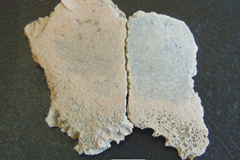
TANZANIA: A case of childhood anemia indicates that early humans relied on meat as part of their diets as many as 1.5 million years ago—and sometimes did not get enough. In fragments of the skull of a two-year-old hominin, researchers found evidence of porotic hyperostosis, a condition associated with nutritional deficiencies related to a lack of meat consumption. The scientists conclude that people must have been hunting at the time, as scavenging would not have yielded enough meat to make it such an essential dietary need. —Samir S. Patel
SENEGAL
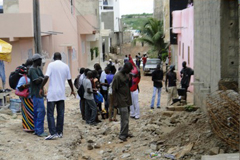
SENEGAL: Flooding in the Dakar suburb of Ouest-Foire has revealed hundreds of shell beads, pieces of pottery, stone and iron tools, and other Neolithic artifacts that could date to 3000 B.C. The items were found by accident while a local archaeologist was examining a construction site damaged by torrential rains. The site is now heavily disturbed and further excavation will be difficult because of the rapid, anarchic pace of building around the capital. —Samir S. Patel
POLAND
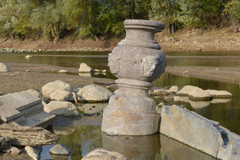
POLAND: Record low water levels on the Vistula River due to heat and drought have revealed a trove of 17th-century plunder. Marble and alabaster decorative structures, including a fountain, vases, and steps, as well as cannonballs and wheels from cannon wagons, emerged from the mud. They were probably looted from royal residences after a 1665-1666 Swedish invasion, and ended up on the riverbed when a barge carrying the items sank. —Samir S. Patel
DENMARK
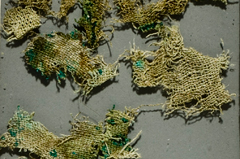
DENMARK: Examination of textiles found wrapped around cremated remains in a 2,800-year-old bronze urn show that wild nettles were used to make cloth in the Bronze Age, calling into question the assumption that only cultivated plants, such as flax and hemp, were used for textiles in the period. Further, the nettles were imported from an area where flax was being grown—meaning that, for reasons unknown, they were chosen over their cultivated counterpart. The textile was of very high quality, with a dense tabby weave. —Samir S. Patel
IRELAND
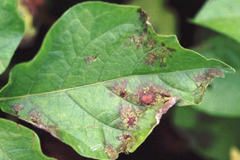
IRELAND: An Gorta Mór ("The Great Hunger"), as the 1840s famine is known in Irish, led to the deaths of 1.5 million people and the emigration of two million more. The famine was caused by Phytophthora infestans, a microorganism that causes the plant disease known as potato late blight. Researchers have now extracted genetic data for the pathogen from ground-up, rotten potato samples from 19th-century experiments. They found that the same lineage of P. infestans was responsible for another epidemic 30 years later, and are now sequencing the whole genome to see how it changed over time. —Samir S. Patel
VIRGINIA
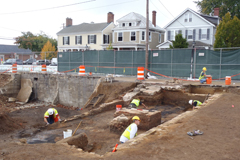
VIRGINIA: The Battle of Fredericksburg in December 1862 was a major Confederate victory. An archaeological dig preceding construction of a new courthouse has revealed the foundations and intact carbonized floorboards of a building likely destroyed near the end of the battle. Finds inside—including bullets and metal uniform insignias indicating Company C of a regiment designated with a "2"—suggest that Union soldiers took shelter in the row house. —Samir S. Patel
CANADA
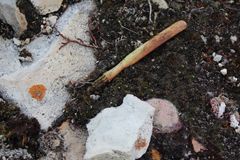
CANADA: Parks Canada archaeologists have, for several years now, been searching for evidence of Sir John Franklin's doomed 1840s expedition to traverse the Northwest Passage, including the remains of his ships, HMS Erebus and Terror. Another season has passed without sign of the ships, but on land, archaeologists have continued to find artifacts. At a previously excavated site on Erebus Bay, where the expedition crew was stranded and around 20 of them died, researchers found more pieces of human bone, buttons, scraps of cloth, and a bone-handled toothbrush. —Samir S. Patel
CALIFORNIA
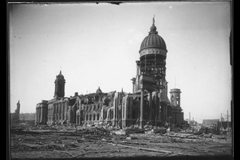
CALIFORNIA: At 7.9 on the Richter scale, the 1906 earthquake in San Francisco and the resulting fires destroyed 80 percent of the city, including its imposing city hall, which was completed just 10 years before. Workers digging recently under the sidewalk on Hyde Street to plant a tree uncovered bricks and mortar from the structure. While remains of this building often turn up in the area, preservation specialists were surprised to find such large portions of its foundations still intact. —Samir S. Patel