Voyage to Crete: Monastiraki
by Eti Bonn-Muller
August 2, 2009
Logic would dictate that I continue making my way eastward, but the opportunity for a second meeting with Elpida Hadjidakis at Falasarna lured me back west yesterday. I’ll be reporting separately on our conversation regarding a groundbreaking discovery she made at another site.
Today, I was delighted also to meet again with Athanasia Kanta, director of Iraklion’s Archaeological Museum. The experienced and passionate archaeologist, who has dug at sites all over Crete, guided me through Monastiraki (named after a small monastery in a nearby village of the same name), where she has been leading excavations since 1980. The Minoan site, which lies in the Amari Valley near the southwest foothills of Mt. Ida, was a major center for wine and cloth production during the Protopalatial period (Middle Bronze Age). Kanta also believes it had a close and special relationship with the palace at Phaistos.
The last year of large-scale excavations at Monastiraki was 1999. Over the past decade, Kanta has focused on studying and publishing material from this fascinating site.
1
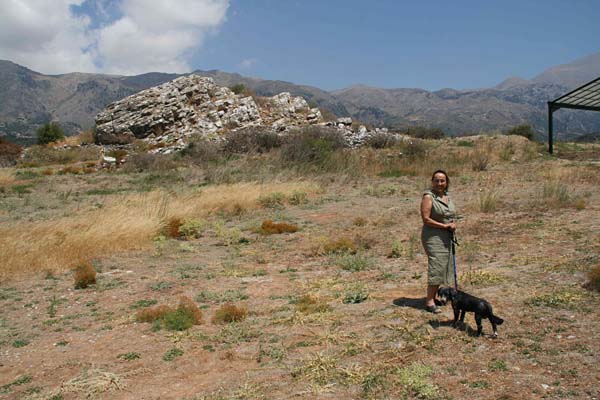
Image 1 of 8
Kanta and her dog Hercules stand in front of a natural rock formation at Monastiraki. The rock was originally covered with thick, coarse, white plaster--her team has collected bagfulls of it--a feature not found at any other site on Crete. On the side of the rock, the archaeologists discovered narrow terraces made of little stones, presumably to facilitate climbing to the top, which had been leveled.
The rock may have provided a vantage point from which people could watch over the surrounding roads. But trial trenches at its base have revealed an intriguing discovery that may lead to another interpretation: a 5.9-inch-tall statuette made of fine clay in the barbotine technique that depicts a couple embracing--a young male and a naked, older female (his head nestled in her breasts). Kanta believes that it is not an erotic pose--one of the man's arms clearly separates the two--but rather a Minoan goddess and either her consort or the ruler of the area. (Parallel examples exist in Egypt and Syria.) The find suggests the rock may also have had religious significance, but further excavations are needed before any conclusions can be drawn.
This entry was posted by Eti Bonn-Muller on
Sunday, August 2, 2009.
Discussion of this blog entry is now closed.
Comments posted here do not represent the views or policies of the Archaeological Institute of America.