
Email this article
|
|
Writers' Guidelines
|
|
|
|
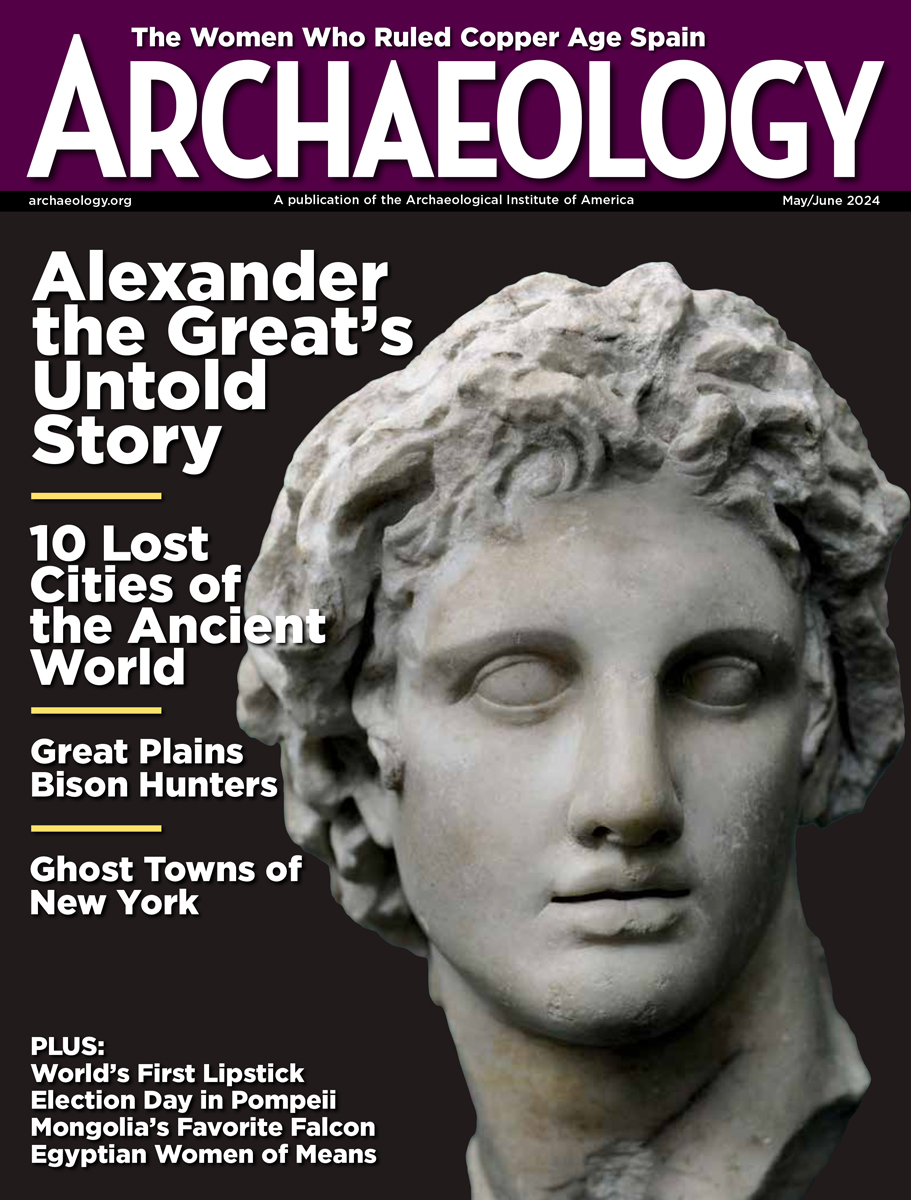
ARCHAEOLOGY magazine is a publication of the Archaeological Institute of America, a 130-year-old nonprofit organization. The magazine has been published continuously for more than 60 years. We have a total audience of nearly 750,000, mostly in the United States and Canada. Our readership is a combination of the general public, enthusiastic amateurs, and scholars in the field. Publishing bimonthly, we bring our readers all of the exciting aspects of archaeology: adventure, discovery, culture, history, technology, and travel.
Authors include both professional journalists and professional archaeologists. If you are a scientist interested in writing about your research for ARCHAEOLOGY, see below for tips and suggestions on writing for a general audience.
What we publish:
Our feature-length articles cover the world of archaeology and feature intriguing insights into a period of history or prehistory. Archaeology isn't just about digging, and we're always looking for a new angle on a subject. Recent articles have covered such diverse subjects as Turkey’s claim to the world’s first temple, a diet for Roman gladiators, Polynesian Mormons in Utah, why flattened foreheads and filed teeth made the Maya beautiful, and how Egypt’s Great Pyramid was built.
Our reviews department looks for short (250- to 500-word) articles on museums, books, television shows, movies, websites, and games of interest to our readers. While the material reviewed may not be purely archaeological in nature, it should have a strong archaeological element to it. Reviews should not simply summarize the material, but provide a critical evaluation.
Insider is a piece of about 2,500 words dealing with subject matter with which the author has an intimate, personal interest. A recent example includes a first hand look at the deterioration of the world’s most famous wall paintings at the French site of Lascaux and who bears the blame for it, written by an authority on Paleolithic cave art.
Conversation is a one-page interview in a Q&A format with someone who has made a considerable impact on the field of archaeology or has done something unusual or intriguing. The interview may explain the researcher's general approach to his or her subject, or concentrate on a specific, and often controversial, discovery or theory.
Letter From... is an account of a personal experience involving a particular topic or site. "Letters" have included a visit to an alien-archaeology theme park, the account of an archaeologist caught in a civil war, and an overnight stay with the guards at Angkor Wat. "Letters" are usually about 2,500 to 3,000 words in length.
Artifact is the last editorial page of the magazine. Its purpose is to introduce the reader to a single artifact that reveals something surprising about a site or an historical event. Unusual artifacts recently excavated are preferred and visuals must be of the highest quality. The writer must explain the archaeological context, date, site found, etc., as well as summarize the artifact's importance in about 200 words or less. First person accounts by the actual excavators or specialists are preferred, although exceptions are be made.
We do not accept fiction, poetry, or previously published articles.
Queries. Preliminary queries should be no more than one or two pages (500 words max.) in length and may be sent to the Editor in Chief, ARCHAEOLOGY, 36-36 33rd Street, Long Island City, NY 11106 or via e-mail to editorial@archaeology.org. We do not accept telephone queries. Check our online index and search to make sure that we have not already published a similar article.
Your query should tell us the following: who you are, why you are qualified to cover the subject, how you will cover the subject (with an emphasis on narrative structure, new knowledge, etc.), and why our readers would be interested in the subject. Clips and credentials are helpful.
While illustrations are not the sole responsibility of the author, it helps to give us a sense of how the article could be illustrated; if possible, email an example of two or three images that might accompany the article (noting where and from whom such images may be obtained). Please do not e-mail unusually large images or too many images at a time; we will request additional ones if needed. Please do not mail us unsolicited cds, transparencies, or slides as they will not be returned. If you do not have access to images, referrals to professional photographers with relevant material are appreciated.
Unsolicited article pitches should receive a reply within six to eight weeks. Commissioned articles found unsuitable for publication will receive a kill fee of one-quarter of the agreed payment price.
Please be familiar with our magazine and what we publish before you write a query. For a sample copy of ARCHAEOLOGY, send a self-addressed stamped 9"x12" envelope to Guidelines, ARCHAEOLOGY,
36-36 33rd Street, Long Island City, NY 11106. Back issues can be ordered on www.archaeology.org.
Manuscripts. Accepted manuscripts should be sent electronically in a universal format, with no embedded images. The author's name and contact information must be included. Authors should be prepared to provide a list of publications and people consulted, along with contact information for each source.
Style. Dates use A.D. and B.C., measures must be in miles and feet. When in doubt, refer to the Chicago Manual of Style, 15th edition.
Rights and payment. We purchase exclusive worldwide publication rights for texts. News and review articles are included in full on www.archaeology.org; feature articles are abstracted. Material published in ARCHAEOLOGY may be reproduced on our web site as purchasable html or pdf format files, and via third-party databases such as EBSCO, in books of collected articles from ARCHAEOLOGY, and in translated form.
Tips for academic writers:
This is not an academic publication. It's critically important to remember that less than one-half of one percent of our readers are professional archaeologists. Your proposal must clearly spell out why the other 99.5 percent of our readership--a diverse group including everyone from college-age newsstand buyers to retirees who have subscribed to the magazine for decades--would be interested in your story. Some research--say, the variance in arsenic levels of metal objects produced in the Near East from the beginning to end of the Assyrian period--is a hard sell for a popular publication. On the other hand, offbeat topics such as the archaeology of the homeless and how cosmic rays allow archaeologists to “see” inside ancient pyramids made for accessible articles that give our readers what they're looking for--a fresh and interesting perspective on human history.
Put yourself in the piece. Many scientists are consistently surprised by the fact that the public is not just interested in what they do, but who they are. This is especially true for archaeologists: chances are you've traveled to more interesting places, met more interesting people, and had many more interesting adventures than most people. Nobody becomes an archaeologist to get rich, they do it for the experience; let the person who grew up wanting to be an archaeologist but ended up a lawyer live vicariously through you!
Don’t lose readers in technical details. If you're writing about a fabulous discovery you made in the depths of the rain forest, bring the complete experience to your readers: What does the jungle look like, smell like? What animals are lurking in the underbrush? What's camp like? If you only have a limited number of sentences to evoke a site for a lay reader, you're better off describing the looming mountains or sunbaked bricks rather than the fact that the 4.5x10-foot structure is 3.3 feet south of the 15-foot-square platform, which is 10 feet from the two cooking pits, each averaging 24 inches in diameter. Explain or avoid technical or local terms and excessive jargon.
Engage the locals. If you're ready to tell us about the remarkable discoveries you've made in your 10 years of work at site X, solicit thoughts and opinions from the people who live around site X. Does it give them a new perspective on where they live? Has it taught them something about themselves? How has having an archaeological expedition around for a decade affected their lives? What role will they have in managing the site you've excavated? Are they glad to see your noisy Land Rovers go?
Talk to us. ARCHAEOLOGY understands the importance of sharing your research with the public, and we've been helping archaeologists do just that for more than 60 years. If you'd like to explore the possibility of publishing your work in the world's largest-circulation archaeology magazine, please contact us at editorial@archaeology.org, and we'll put you in touch with the editor who can best assist you.

© 2010 by the Archaeological Institute of America www.archaeology.org/write/guidelines.html |
|