Digital Reconstruction Depicts Face of “Jericho Skull”
BRASILIA, BRAZIL—Live Science reports that graphics expert Cícero Moraes and his colleagues have created a digital reconstruction of the so-called Jericho Skull, one of seven 9,000-year-old skulls found in the West Bank in 1953 by British archaeologist Kathleen Kenyon. Now held at the British Museum, this skull, at first thought to have belonged to a woman, was packed with earth and encased in plaster with cowrie shells for eyes. Some of the Jericho skulls also bore traces of brown paint. Now believed to have belonged to a man, Moraes’ reconstruction of the skull is based upon published measurements taken during a 2016 micro-computed tomography scan and statistical projections derived from the CT scans of thousands of living people. The resulting image depicts a dark-haired man between the ages of 30 and 40. The study also suggests that his cranium was larger than average, and may have been elongated when the individual was young, Moraes said. Read the original scholarly article about this research in OrtogOnline. To read about a previous reconstruction of a Jericho skull, go to "Neolithic FaceTime."
Fragments of Crocodile Skulls Found in Ancient Egyptian Tombs
LUXOR, EGYPT—Science in Poland reports that fragments from nine crocodile heads were recovered from two tombs located near the Temple of Hatshepsut in the North Asasif necropolis. The skulls, which belonged to young and adult crocodiles, had been discarded by an explorer more than 100 years ago. “This is a unique discovery, because until now no graves containing crocodiles were known in Egypt,” said Patryk Chudzik of the University of Warsaw. The heads had not been mummified, Churdzik explained, although crocodile mummies have been found in temples. One of the tombs belonged to Cheti, an official during the reign of Mentuhotep II, who ruled from about 2051 to 2000 B.C. The other tomb is thought to have belonged to a vizier who served the same pharaoh. The crocodile heads may have been intended to assist the deceased in the afterlife, Chudzik said, and likely offered the protection of Sobek, an ancient Egyptian deity depicted as a crocodile or a man with a crocodile head. As Sobek-Ra, the god was also a powerful solar deity, he added. To read about ancient Egyptian animal mummies, go to "Messengers to the Gods."
Lidar Survey Pushes Back Advent of Maya Calendar
LJUBLJANA, SLOVENIA—According to a Science News report, lidar surveys of 415 ceremonial complexes built by the Olmec and the Maya along Mexico’s Gulf Coast have revealed that the structures were aligned on an east-west axis to mark the rising and setting of celestial bodies on particular days in a 260-day calendar. The structures have been dated from 1100 B.C. to A.D. 250. The earliest known written evidence of the Maya 260-day calendar dates back to about 300 B.C., although researchers suspected that the calendar had been developed before a system of writing had been created to keep track of it. Ivan Šprajc of the Slovenian Academy of Sciences and Arts, Takeshi Inomata of the University of Arizona, and Anthony Aveni of Colgate University explained that such a calendar would have allowed the people to coordinate seasonal farming activities and plan corresponding rituals. Read the original scholarly article about this research in Science Advances. For more on the Maya calendar, go to "Earliest Maya Calendar Date," one of ARCHAEOLOGY's Top 10 Discoveries of 2022.
Scandinavia’s Genetic History Explored
STOCKHOLM, SWEDEN—According to a statement released by Cell Press, Ricardo Rodríguez-Vaela of Stockholm University and his colleagues analyzed 249 published ancient human genomes; 48 additional genomes from boat burials, Viking chamber burials, the Sandby borg ringfort, and the Kronan, a seventeenth-century warship; and genetic data from more than 16,500 living Scandinavians to investigate how past migrations of people into the region have contributed to the modern Scandinavian population. From the eighth to the eleventh century, the Norse conducted recurrent raids on the British-Irish Isles, and likely returned to Scandinavia with enslaved people, voluntary immigrants, and Christian missionaries and monks. The researchers also found that traces of British and Irish ancestry were widespread in Scandinavia during the Viking period. Genetic traces of Viking-era women from the Baltic were detected in remains from the Baltic Sea island of Gotland and central Sweden. Modern Scandinavians appear to have inherited few of these migrants’ genes, however. The researchers also detected variations in levels of Uralic ancestry in modern Scandinavians. “We need more pre-Viking individuals from north Scandinavia to investigate when the Uralic ancestry entered this region,” Rodríguez-Vaela said. Additional DNA samples from the medieval period could also help the researchers understand the drop in nonlocal ancestry in some regions, he added. Read the original scholarly article about this research in Cell. To read more about the Vikings' genetic diversity, go to "Largest Viking DNA Study," one of ARCHAEOLOGY's Top 10 Discoveries of 2020.
16th-Century Ship Discovered in England
KENT, ENGLAND—Live Science reports that a section of the hull of an Elizabethan ship was found last spring while workers were dredging up gravel in a flooded quarry on the Dungeness headland in southeastern England. Dendrochronological analysis of more than 100 timbers from the hull indicate that the English oak trees used to build it were felled between 1558 and 1580. At that time, the quarry was likely to have been much closer to the coastline than it is today. The vessel may have wrecked on the rocks, or it may have been abandoned there if it had become unseaworthy. Marine archaeologist Andrea Hamel of Wessex Archaeology and her colleagues said the ship had been built in the “carvel” construction style, in which flush hull planks were nailed to an internal frame. This construction technique was replacing older building styles during this period, so the hull will help scholars understand the transition, according to Antony Firth of Historic England. The timbers will be reburied in the quarry’s protective layer of silt once the researchers have completed documenting them with laser scanning and digital photography. To read about the origins of crewmembers of an English warship that sank in 1545, go to "Tudor Travelers."
New Thoughts on Some Abstract Marks in Paleolithic Paintings
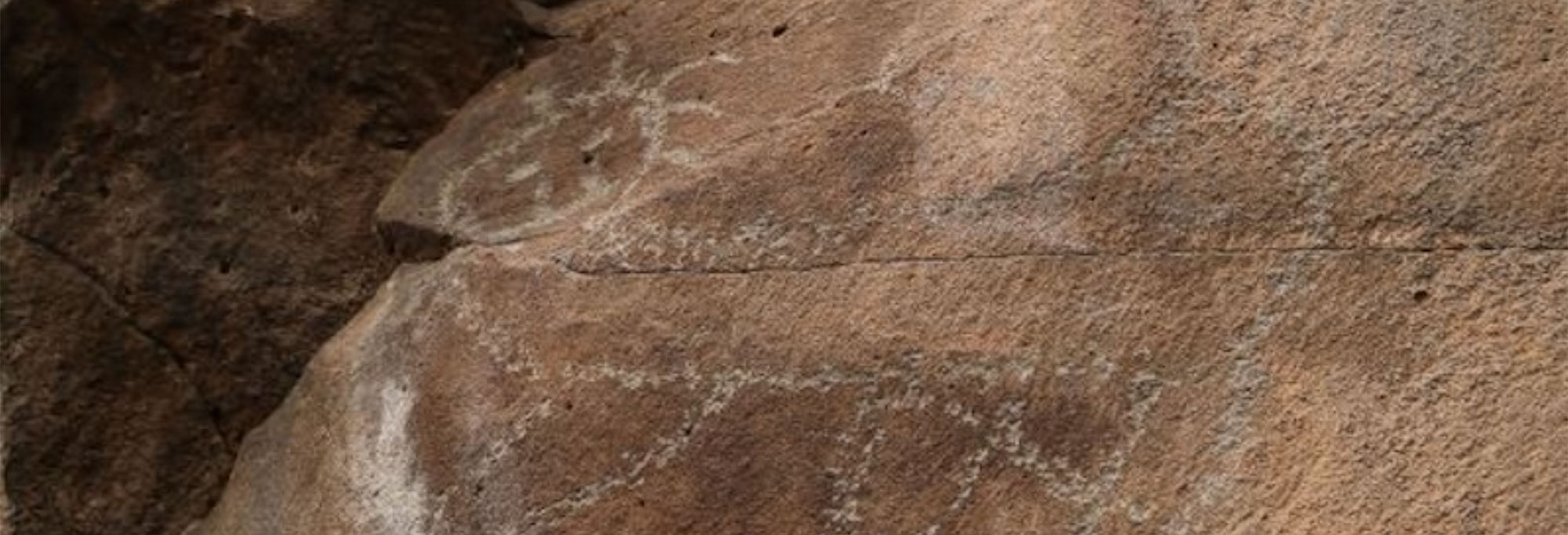
LONDON, ENGLAND—Independent researcher Bennett Bacon, Paul Pettitt and Robert Kentridge of Durham University, Tony Freeth of University College London, and their colleagues analyzed more than 800 sequences of three specific abstract marks in Europe’s Paleolithic cave art, according to a Live Science report. Those marks, positioned near images of animals, include varying combinations of dots, lines, and a Y-shaped sign. The researchers note that none of the sequences contain more than 13 marks, and suggest that the marks could convey information about the 13 months in the lunar calendar. They then found strong correlations between the number of marks near the image of an animal and the time of year in which that animal mates. The Y-shaped signs, they added, could signal a particular event, such as the animal’s birthing season. Bacon said that such information on seasonal migration, mating, and birth would be valuable to Paleolithic hunters because the animals would be more vulnerable during these times. Critics note that many more signs recur in the region's rock art than the researchers have studied, and that the marks they analyzed could be interpreted in other ways. Read the original scholarly article about this research in Cambridge Archaeological Journal. To read about rock art elements that hunter-gatherers living in Texas and Mexico may used to depict speech, go to "Speak, Memories."
High-Tech Tools Offer a Glimpse Into a Medieval Reliquary
MUNICH, GERMANY—According to a statement released by the Technical University of Munich, Prompt Gamma Activation Analysis (PGAA) and neutron tomography were employed to look inside a pendant recovered from a medieval garbage pit in the Old City section of Mainz in 2008. The enameled and gold-plated copper pendant, dated to the twelfth century, bears Christian images of Jesus, Mary, the four Evangelists, and four women saints. Traces of a silk cord were detected on its attachment loop, indicating that the pendant may have been worn as a protective talisman. Matthias Heinzel of the Leibniz-Zentrum für Archäologie (LEIZA) said attempting to open the lock mechanism on the pendant would have destroyed it, but the neutron tomography conducted at the Technical University of Munich revealed that it contained five packets made of silk and linen concealing tiny bone fragments without harming the delicate object. Heinzel and his colleagues were even able to measure the size of the threads with this process. Reliquaries such as this one usually contain a strip of parchment indicating the name of the saint whose bone it holds, Heinzel added. The researchers did not spot one in this study, however. To read about a reliquary that may contain the remains of an Anglo-Saxon princess, go to "ID'ing England's First Nun."
Study Investigates Source of Amazon’s “Dark Earth”
CHICAGO, ILLINOIS—Science News reports that the ancient patches of fertile land known as Amazonian Dark Earths (ADEs) found near archaeological sites in the Amazon River basin may have been created intentionally, based upon a new study of the practices of the Kuikuro people, who live in southeastern Brazil. Some have argued that ADEs were formed through geologic processes, but the Kuikuro create enriched soil, known as eegepe, around their villages today with ash, food scraps, and controlled burns. Morgan J. Schmidt and Taylor Perron of the Massachusetts Institute of Technology and their colleagues compared samples of ADEs collected from areas around Kuikuro villages and archaeological sites in Brazil’s Xingu River basin and found that they are both far less acidic than the surrounding soils, perhaps as a result of the addition of ash. The ADEs also contained higher levels of nutrients needed for growing crops. Finally, the researchers found that the samples held about twice the amount of carbon than the surrounding soils. “People in the ancient past figured out a way to store lots of carbon for hundreds or even thousands of years,” Perron concluded. For more, go to "Dark Earth in the Amazon."
Ice Age Hunting Camp Identified in Mexico
MEXICO CITY, MEXICO—According to a Mexico News Daily report, researchers led by Patricia Pérez Martínez of Mexico’s National School of Anthropology and History (ENAH) re-evaluated mammoth bones and stone tools recovered during a construction project in central Mexico in the 1950s. Martínez and her colleagues determined that the objects came from a site that served as a seasonal hunter-gatherer camp on the shores of Lake Texcoco some 9,000 years ago. The tools, originally thought to have been projectile points, may have been knives used for butchering, she said. The camp is unusual, Martínez explained, because similar camps are usually found in caves and rock shelters in mountainous regions of northern Mexico, and not in the open air. Fish bone fragments found at the site suggest that these hunter-gatherers also caught fish in the lake and cooked them with charcoal. The team will continue to study the collection of bones and artifacts, and return to the site to collect soil samples for analysis and conduct additional excavations, Martínez added. To read about a remarkably preserved collection of wooden artifacts recovered at the foot of the Templo Mayor in Mexico City, go to "Aztec Offerings," one of ARCHAEOLOGY's Top 10 Discoveries of 2022.
Advertisement