Head Wounds of Medieval Victim Analyzed
CITTIGLIO, ITALY—Live Science reports that a team of researchers led by Chiara Tesi of the University of Insubria re-analyzed the 700-year-old remains of a man who died between the ages of 19 and 24 from brutal head wounds with computed tomography scans, 3-D X-ray scans, and precision digital microscopy. The remains were found at the church of San Biagio, which is located in northern Italy. Tesi thinks the young man may have been a member of the powerful De Citillio family that established the church in the eighth century A.D. She said that the victim appears to have dodged an initial sword attack to the front of his head, where the researchers identified a shallow lesion. But they found deep wounds on the back of his head that may have been inflicted as the young man tried to flee his attacker. One of these was found near an ear, and the other on the back of the neck. “At the end, probably exhausted and face down, he was finally hit by a last blow to the back of the head that caused immediate death,” Tesi said. Such a frenzied attack suggests the attacker was determined to complete the kill, she surmised. To read about the remains of a man who appears to have been executed in eleventh-century Sicily, go to "Stabbed in the Back."
U.S. Museum Repatriates Sarcophagus to Egypt
CAIRO, EGYPT—The Guardian reports that a wooden sarcophagus held at the Houston Museum of Natural Science has been repatriated to Egypt. Mostafa Waziri of Egypt’s Supreme Council of Antiquities said that surviving inscriptions on the coffin, which measures nearly 10 feet long, suggest it may have belonged to a priest named Ankhenmaat. He also explained that the coffin has been dated to Egypt’s Late Period, between about 712 and 332 B.C. The sarcophagus was looted from northern Egypt’s Abusir necropolis by an art trafficking network, and was smuggled through Germany and into the United States in 2008, according to Manhattan district attorney Alvin L. Bragg. A collector later loaned it to the museum in 2013. For more on Abusir, go to "In the Reign of the Sun Kings."
Possible Roman-Era Mausoleum Uncovered in France
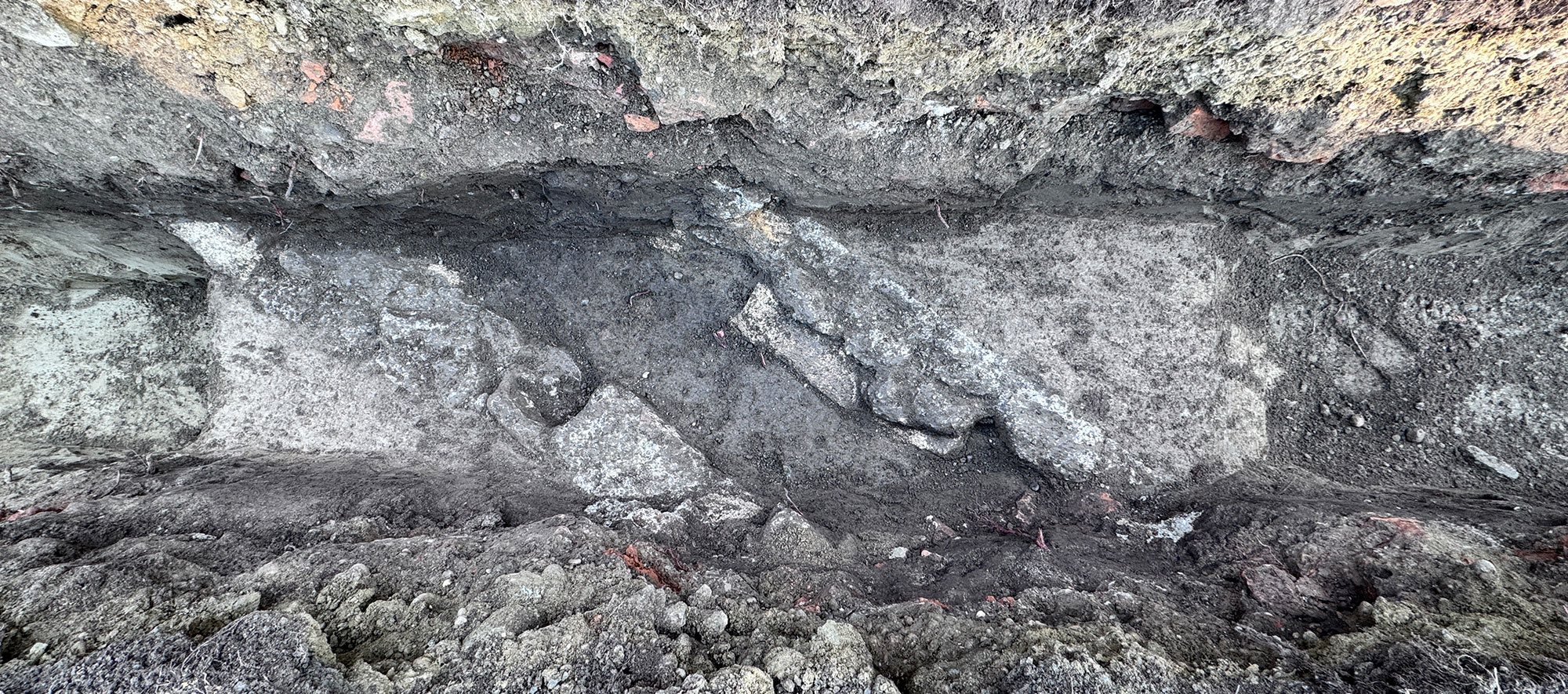
AUVERGNE, FRANCE—According to a statement released by France’s National Institute of Preventive Archaeological Research (INRAP), the remains of a possible mausoleum have been found among several buildings at a Gallo-Roman site in central France. When the sandstone blocks were cleaned, the researchers found a cornice decorated with leaves surmounted by a Corinthian capital, and a frieze fragment showing an image of the Greek sea god Triton with a beard, long hair, spread arms, and tentacles ending in palm leaves. A possible seahorse, whose two front legs are visible, was placed next to him. Two pieces of a conical sculptural element covered with finely carved scales were also found. This element is thought to have rested on the top of the monument. The researchers explained that the sea monster motif was often used on mausoleums in the first and second centuries A.D. to symbolize the journey made by the deceased. To read about a Gallo-Roman necropolis in southwest France, go to "Shackled for Eternity."
Egyptian Birds Identified in Ancient Palace Painting
OXFORD, ENGLAND—According to a statement released by Antiquity, researchers Christopher Stimson and Barry Kemp of Oxford University have identified 12 bird species depicted in a naturalistic painting on plaster walls in a palace at the site of the ancient capital of Amarna. The palace belonged to Meritaten, a daughter of Nefertiti and the pharaoh Akhenaten, who ruled from about 1349 to 1336 B.C. The rare painting, discovered during a 1924 excavation, shows the birds in a wild papyrus marsh without any humans. An attempt to conserve it in 1926 caused some damage and discoloration, Stimpson explained. He and Kemp used a copy of the painting made in 1924, and compared what they saw with modern ornithological data to identify shrikes and wagtails, in addition to the kingfishers and pigeons identified by previous research. They also noticed that migrant birds are marked with a triangle, perhaps to indicate a season. Rock pigeons, which are not native to Egypt’s marshes, were also included in the painting. The researchers concluded that the pigeons may have been drawn to the area by human activity, just like modern pigeons. Alternatively, Stimson and Kemp think rock pigeons, which lived in desert cliffs, may have been included in the painting to make the image appear wild and untamed. Read the original scholarly article about this research in Antiquity. To read about an Amarna burial chamber that some believe was Nefertiti's tomb, go to "In Search of History's Greatest Rulers: Nefertiti, Great Royal Wife and Queen of Egypt."
2,000-Year-Old Fountain Restored in Turkey
BURDUR, TURKEY—According to an Anadolu Agency report, a 2,000-year-old monumental fountain in southwestern Turkey’s ancient city of Kibyra has been restored. The 26-foot-tall fountain features two pools reconstructed with more than 150 architectural fragments recovered during excavations and 24 blocks fashioned by the conservation team, which was led by archaeologist Sukru Ozudogru of Mehmet Akif Ersoy University. The fountain was used in Kibyra for some 600 to 700 years, Ozudogru said. The fountain will soon operate again, he added. “Just like in ancient times, fresh spring water will flow into the pool from the mouths of the lion and panther statues in the lion’s hide where the mythological hero Herakles laid down, and the panther’s hide where the god of wine Dionysus lay down,” Ozudogru concluded. To read about an urban park in Turkey's ancient city of Aphrodisias that had fountains and a monumental pool, go to "The Archaeology of Gardens: Urban Gardens."
Advertisement