Subscribe to Archaeology
Archaeological Headlines By JESSICA E. SARACENI
Friday, November 4

Thor's Hammer Amulet Found in Sweden

YSBY, SWEDEN—Ahead of construction of a housing development at a site in southwestern Sweden, archaeologists unearthed a metal amulet in the shape of Mjölnir, the Norse god Thor's hammer, Live Science reports. Dating to the period between the ninth and eleventh centuries A.D., the amulet is the first of its kind to be found in this region. It is decorated with embossed designs, and may have originally been covered in gold or silver. A hole through the hammer's handle would have enabled the amulet to be strung and worn as jewelry. According to archaeologist Per Wranning of the Halland Museum of Cultural History, people might have worn objects like this to signal their religious leanings at the end of the Viking Age, when Christianity began to supplant worship of the old Norse gods in Scandinavia. Researchers have also excavated firepits, postholes, pottery, and other metal items at the site. To read about excavations of a Viking-era Norse temple, go to "Around the World: Norway."

Traces of Psychoactive Plants Detected in Hair of Ancient Peruvians

WARSAW, POLAND—According to a Live Science report, researchers have detected traces of plants with psychoactive properties in hair samples taken from ancient Nazca mummies and severed trophy heads of sacrificial victims who died between 100 B.C. and A.D. 450 on the southern Peruvian coast. The team's toxicological analysis identified consumption of coca leaves as well as Banisteriopsis caapi, the primary compound in the hallucinogenic beverage ayahuasca. Hair from one of the preserved trophy heads indicated that the deceased child had ingested San Pedro cactus, a source of the hallucinogenic drug mescaline, before being executed. "The trophy head is the first case of the consumption of San Pedro by an individual living on the southern Peruvian coast," said Dagmara Socha of the University of Warsaw. "It's also the first evidence that some of the victims who were made into trophy heads were given stimulants before they died." Read the original scholarly article about this research in Journal of Archaeological Science. To read about a 1,000-year-old bundle of drug paraphernalia found in Bolivia, go to "Half in the Bag."

Thursday, November 3

DNA Study Reveals Human Migration Routes in South America

BOCA RATON, FLORIDA—According to a statement released by Florida Atlantic University, DNA analysis of the remains of two individuals who lived some 1,000 years ago in northeast Brazil has yielded new information about the migration routes of humans in South America. A multidisciplinary team of archaeologists, biologists, and computer scientists has now compared the genomes of these ancient Brazilians to ancient and present-day genomic data taken from people in northeast and southeast Brazil, Uruguay, and Panama, and found distinct relationships between them. Archaeological evidence for the initial peopling of the Americas indicates that Indigenous peoples migrated from the north into South America. The researchers' new findings suggest that Indigenous people also settled along the Atlantic coast of South America about 1,000 years ago, after the peopling of the Pacific coast and the Andes occurred. The team also identified Denisovan and Neanderthal ancestry in the DNA of the ancient individuals sampled. To read about ancient populations who migrated to the Yucatán Peninsula from South America some 5,600 years ago, go to "The Great Maize Migration."

Inscribed Pictish Stone Unearthed in Scottish Cemetery

PERTHSHIRE, SCOTLAND—Live Science reports that a stone cross slab carved by the Picts between A.D. 500 and 700 was uncovered in a cemetery near the village of Doune in central Scotland. In addition to a knotted circular cross, the stone, which measures about four feet tall and three feet wide, is decorated with birds, a bull, and an inscription in ogham, a medieval alphabet that was used to write the early Irish language. Stirling Council archaeologist Murray Cook said that the cross slab is the first to be found in the region, which in antiquity served as a neutral zone between the Picts and invading Romans, and later, Britons. He suggests that the inscribed stone might have originally been a public monument commissioned by a wealthy individual who wished to signal both their Pictish heritage and Christian identity. "The tips of the scrolls [of the cross] end with bird heads; they might be pelicans, as there is a tradition of the pelican biting its own flesh to feed to its young, echoing Christ and the Last Supper, which becomes the Eucharist," he said. "The bull might be a symbol of a family, a region, or a god." To read about another rare Pictish stone recently found in eastern Scotland, go to "Pictish Pictograms."

Wednesday, November 2

Viking Age Silver Hoard Discovered in Sweden

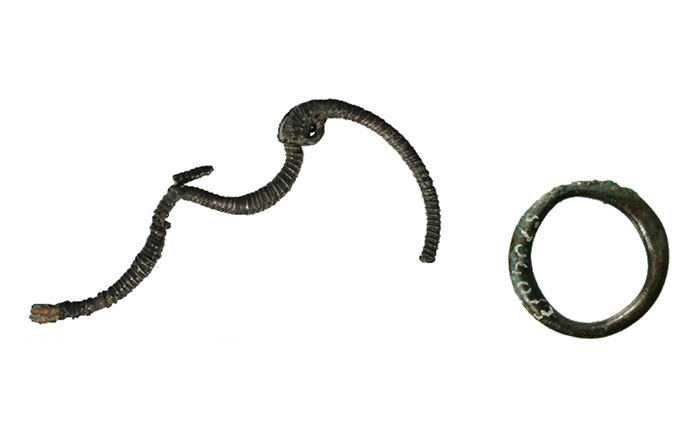
STOCKHOLM, SWEDEN—A trove of silver objects dating to some 1,000 years ago was uncovered beneath the remains of a building at a Viking Age settlement outside Stockholm, according to a statement released by Sweden's National Historical Museums. Thus far, archaeologists have unearthed more than 20 houses and other buildings at the site, which was occupied from at least A.D. 400 through the early Middle Ages. The artifacts in the hoard include pearls, neck and arm rings, and coins from both the European and Arab worlds. It is unclear why these objects were buried, said archaeologist John Hamilton, though a common assumption is that people hid items during particularly difficult or troubling times. To read about a massive cache of Viking silver and Anglo-Saxon heirlooms, go to "Secrets of Scotland's Viking Age Hoard."

Polynesian Tools Uncovered on Norfolk Island

SYDNEY, AUSTRALIA—According to a statement released by the Australian Museum, archaeologists have unearthed two basalt axes and hundreds of stone flakes in a national park on Norfolk Island, an Australian territory in the South Pacific. The tools were made by the island's Polynesian inhabitants between the thirteenth and fifteenth centuries, before Europeans settled there. Nicola Jorgensen of the University of Sydney said that the wealth of material found indicates that the site was a Polynesian settlement. Only one other such settlement has been identified on Norfolk island. The artifacts have enabled researchers to better understand the movement and behaviors of the island's original Polynesian inhabitants, said Australian Museum archaeologist Amy Mosig Way. To read about a 600-year-old canoe whose design indicates cultural continuity with other places in Polynesia, go to "World Roundup: New Zealand."

Advertisement