Marble Reliefs Unearthed at Nineveh
MOSUL, IRAQ—BBC News reports that seven marble reliefs have been unearthed in the ancient city of Nineveh, which is located in northern Iraq, by a team of Iraqi archaeologists led by Fadel Mohammed Khodr in partnership with other international researchers led by Michael Danti of the University of Pennsylvania. The carvings, which date to the reign of the Assyrian king Sennacherib some 2,700 years ago, depict war scenes, grapevines, and palm trees. Khodr said the carvings are thought to have been part of Sennacherib’s palace before they were moved to the city’s Mashki Gate, where they were partially buried. The carvings survive on these buried sections, he explained, while the exposed stone is now smooth. To read about an aurora that Assyrian astronomers recorded on cuneiform tablets found at Nineveh, go to "Around the World: Iraq."
Wealth and Health in Medieval Norway
OSLO, NORWAY—According to a statement released by the Public Library of Science, Elin Brødholt of the University of Oslo and her colleagues analyzed the remains of 227 medieval Norwegians to see if social status was reflected in bone health. The bones of wealthy individuals were recovered from the site of a royal church and a Dominican monastery, while the rest of the remains came from three parish cemeteries. The researchers found significant differences in patterns of bone mineral density and stature between socioeconomic groups—high-status individuals tended to be taller and have higher bone mineral density, likely due to differences in nutrition, activity level, and susceptibility to disease brought about by living conditions, the researchers concluded. Women especially appear to have been affected by these differences, they added. Read the original scholarly article about this research in PLOS ONE. To read about a 1,700-year-old sandal recovered from the ice in a Norwegian mountain pass, go to "Around the World: Norway."
Pages from Ancient Greek Star Map Found in Medieval Text
PARIS, FRANCE—Live Science reports that a fragment of a star map assembled by the ancient Greek astronomer Hipparchus has been revealed with multispectral imaging on nine pages of a medieval religious text known as the Codex Climaci Rescriptus, which was originally held at the sixth-century St. Catherine’s Monastery in Egypt’s Sinai Peninsula. “It was immediately clear we had star coordinates,” said Victor Gysembergh of the French National Center for Scientific Research. The numbers state, in degrees, the length and width of the constellation Corona Borealis, and the coordinates for the stars in its farthest corners. The researchers were able to use the coordinates to determine that they were taken in 129 B.C., about the time that Hipparchus lived on the island of Rhodes. Scholars have only known of Hipparchus’s catalog of some 850 stars from references to it in other works. He noted their locations and brightness, and recognized a shift of about two degrees in the position of distant stars from their original positions. He correctly concluded that this shift was due to the Earth’s wobbling on its axis. These newly identified pages have been dated to the fifth or sixth century B.C. based upon the style of the writing. Read the original scholarly article about this research in Journal for the History of Astronomy. To read about a nearly 4,000-year-old star map uncovered in Germany, go to "Mapping the Past: The Nebra Sky Disc."
Human Burial Uncovered at Mesolithic Campsite in Germany
SCHLESWIG-HOLSTEIN, GERMANY—Live Science reports that prehistoric campsites and a human burial have been uncovered at the Duvensee bog in northern Germany. Hunter-gatherers are thought to have come to what were lakeside camps and camps on islands in the lake between 15,000 and 5,000 years ago to fish and roast hazelnuts. “In the beginning, we have only small hazelnut roasting hearths, and in the later sites, they become much bigger,” explained Harald Lübke of the Center for Baltic and Scandinavian Archaeology. He thinks hazelnut trees may have spread throughout the area as the environment changed. Bone points uncovered along the lakeside campsites are thought to have been used to spear fish. Sitting mats made of bark have also been found in the bog’s damp soil, along with pieces of worked flint and hearths. Cremated human bone discovered on the lakeside has been dated to 10,500 years ago. It is not clear if the bones had been wrapped in hide or bark before they were buried. Lübke concluded that the campsites and the artifacts recovered from the Duvensee bog are similar to those found at Star Carr in northern England. Up until about 8,000 years ago, he explained, the two regions were connected by a now-submerged area called Doggerland, so the communities may have shared technologies. For more on the archaeology of the North Sea, go to "Letter from Doggerland: Mapping a Vanished Landscape."
DNA Analysis Identifies Neanderthal Family Members
LEIPZIG, GERMANY—The Guardian reports that researchers led by Laurits Skov of the Max Planck Institute for Evolutionary Anthropology have caught a glimpse of a Neanderthal community by mapping the DNA of 13 individuals whose remains were recovered from caves in southern Siberia. Among the heavily inbred men, women, and children, the team members identified a father and a teenage daughter; another man who was related to the father; and two second-degree relatives, who may have been an aunt and her nephew. The individuals, who were all alive at the same time, are likely to have been part of an isolated population of fewer than 30 people, Skov explained. The researchers also found that there was more genetic diversity in the Neanderthals’ mitochondria, which is passed through the maternal line, than in their Y chromosomes, which are passed from father to son. This could indicate that women left their home communities to live with male partners, the researchers concluded. To read about hominin interbreeding, go to "Our Tangled Ancestry."
Dairy Fat Detected in Neolithic Pottery from Central Europe
BRISTOL, ENGLAND—According to a statement released by the University of Bristol, dairy fat residues in pottery from Central Europe has been dated to as early as 7,400 years ago. Richard Evershed and Emmanuelle Casanova of the University of Bristol and their colleagues analyzed residues from more than 4,300 vessels recovered from 70 archaeological sites belonging to the Linearbandkeramik (LBK) culture. Milk use was detected in about 65 percent of the Neolithic sites, Evershed explained. The researchers then obtained radiocarbon dates for the pottery with milk residues. “It provides clear evidence that dairy foods were in widespread circulation in the Early Neolithic, despite variations in the scale of activity,” Evershed concluded. Read the original scholarly article about this research in Proceedings of the National Academy of Sciences of the United States of America. To read about evidence for cheese-making in Neolithic Poland, go to "A Prehistoric Cocktail Party."
Neanderthal Diet Explored With New Technique
PARIS, FRANCE—According to a statement released by the French National Center for Scientific Research, zinc isotope analysis of the enamel of a Neanderthal tooth recovered from the Gabasa site in northern Spain indicates that the individual had been a carnivore. Klevia Jaouen and her colleagues also analyzed the bones of other animals known to have been carnivores, such as lynxes and wolves, and herbivores such as rabbits and chamois. They found that the lower the proportions of zinc isotopes in the remains, the more likely the individual is to have eaten a meaty diet. The study further suggests that this Neanderthal probably did not consume the blood of his or her prey. Broken bones at the site, combined with the isotopic data from the tooth, indicate that the Neanderthal did consume bone marrow, however. The researchers plan to continue to test this new method on additional Neanderthal remains recovered from other sites. Read the original scholarly article about this research in Proceedings of the National Academy of Sciences of the United States of America. To read about analysis of microscopic material on Neanderthal teeth from Spain, go to "Neanderthal Medicine Chest," one of ARCHAEOLOGY's Top 10 Discoveries of 2012.
Necropolis Explored at Black Sea Site of Phanagoria
TAMAN PENINSULA, RUSSIA—Haaretz reports that excavation of the necropolis at the ancient city of Phanagoria in southern Russia has unearthed the 1,900-year-old grave of a woman who may have been a priestess of the Aphrodite cult and a man who was buried 1,500 years ago with a sword thought to have been forged in Iran. On the woman’s chest, researchers found an intact silver medallion featuring the goddess Aphrodite Urania and 10 signs of the zodiac to show the goddess in her divine, heavenly form. Maria Chashuk of the Phanagoria Archaeological Expedition, which is supported by the Oleg Deripaska Volnoe Delo Foundation, said the medallion may have been worn as a pendant with a cord strung through a brace on its reverse. The woman also wore silver earrings with dove-shaped pendants, another symbol of Aphrodite Urania. Other goods found in this tomb include a red clay jug with a twisted handle, iron scissors with a bronze handle, a bronze mirror, a string of more than 150 beads, and three bronze coins. Archaeologist Alexey Voroshilov said that the man was buried in a large, opulent tomb with a fine weapon whose wooden hilt was topped with a golden top in the distinctive style of the Sassanid Empire. It is the only one of its kind to have been found in Phanagoria, and it may have been a diplomatic gift, Voroshilov explained, since a mercenary working in the Bosporan Kingdom is unlikely to have owned such an object. The man was also buried with imported glass jugs, wooden and metal utensils, and wooden boxes of cloth. To read about an animal bone gaming piece inscribed with the name of Aphrodite, go to "Artifact."
Possible Burial Place of St. Nicholas Uncovered in Turkey
DEMRE, TURKEY—Live Science reports that archaeologists excavating the site of the sixth-century Christian Church of St. Nicholas near Turkey’s Mediterranean coastline have reached the floor of the fourth-century structure where Nicholas served as Bishop of Myra until his death and burial there in A.D. 343. Osman Eravşar of the Antalya Cultural Heritage Preservation Regional Board said the saint’s sarcophagus was disturbed when his remains were stolen in the eleventh century. He thinks the tomb was originally placed at the base of a fresco of Jesus. To read about figurines unearthed at the ancient city of Myra, go to "Artemis, Apollo, and Friends."
Megalithic Portal Tomb Identified in Ireland
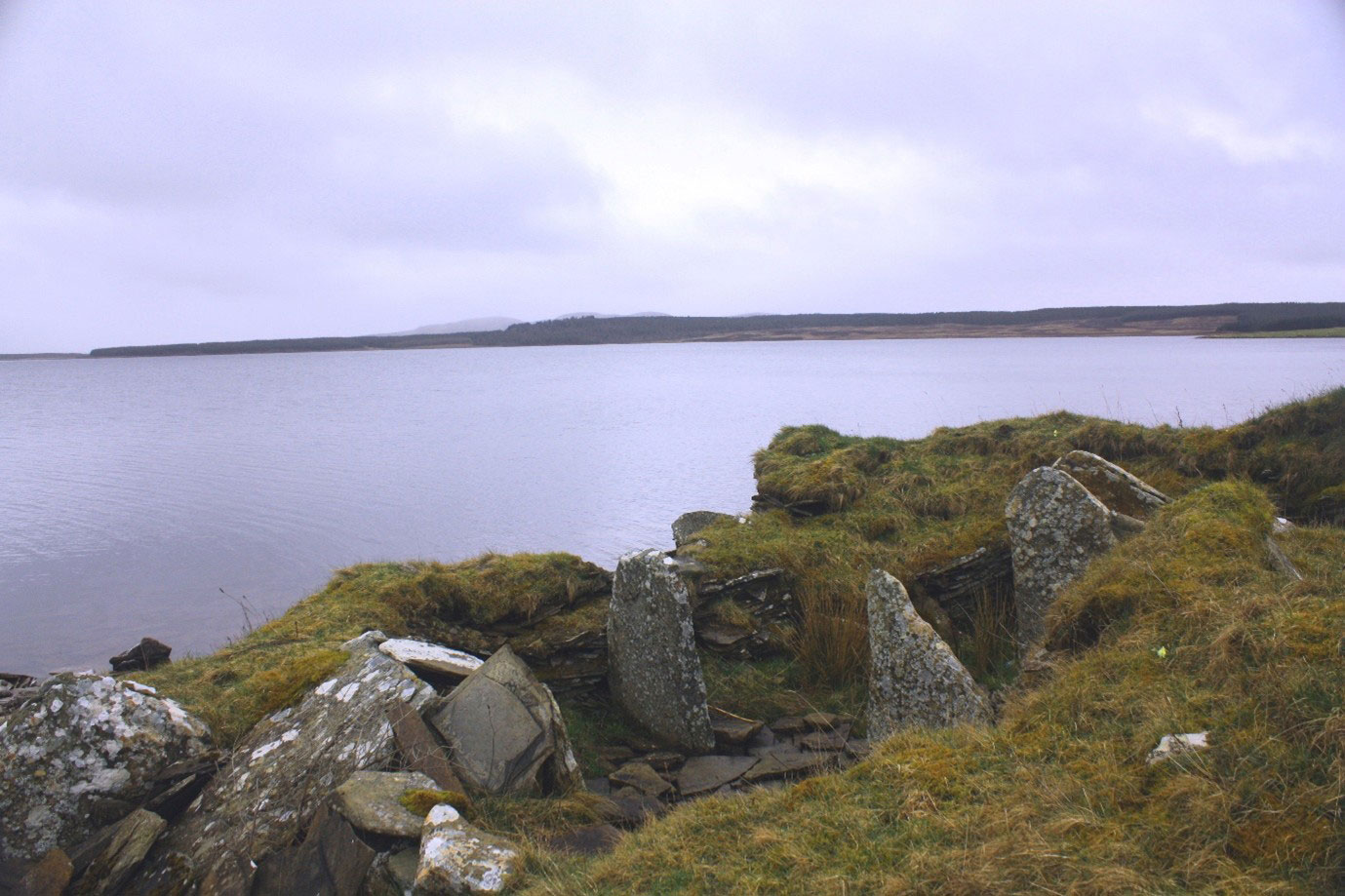
ROSTELLAN, IRELAND—A new study of a stone structure in southern Ireland’s Cork Harbor suggests that it is a megalithic dolmen, and not a nineteenth-century folly connected to Rostellan Castle, as had been previously thought, according to a report in The Irish Examiner. Archaeologist Michael Gibbons said that Carraig á Mhaistin stands at the western end of an 80-foot-long cairn concealed by estuarine mud and rising sea levels. Such cairns may have been built to provide support to portal tombs, he explained. The only other identified intertidal portal tomb in Ireland is in West Cork, on the River Ilen, he added. These tombs may have been part of a wider network of tombs that has not survived in the intertidal zone, Gibbons concluded. To read about a notorious nineteenth-century prison in the middle of Cork Harbor, go to "Letter from Ireland: The Sorrows of Spike Island."
Ancient Golden Belt Discovered in the Czech Republic
OPAVA, CZECH REPUBLIC—Radio Prague International reports that a farmer discovered a metal section of a belt in a beet field in the northeastern Czech Republic. Jiří Juchelka of the Silesian Museum said the 20-inch-long piece of metal, which is mostly gold but also contains some silver and traces of copper and iron, is decorated with raised concentric circles and is topped with rose-shaped clasps at the ends. The style suggests it dates to the late Bronze Age, Juchelka explained. “Belts at the time were made of leather and this was strapped to its front part,” he said. “It was crumpled when the finder found it, probably as a result of agricultural activity, so it is a miracle it has been so well preserved.” The belt will be studied and conserved before it goes on display at the Museum of Bruntál. To read about a Neolithic well that was unearthed in East Bohemia, go to "Around the World: Czech Republic."
Advertisement