Drone Survey Reveals Secrets of Mesopotamian City
PHILADELPHIA, PENNSYLVANIA—According to a Science News report, a drone survey of Lagash, a site situated between the Tigris and Euphrates rivers, indicates the 4,900-year-old settlement was built on four marsh islands. Emily Hammer of the University of Pennsylvania said that it had been previously thought that cities in southern Mesopotamia expanded outward from temples and administrative districts into farmlands. Yet Lagash did not have a geographical or ritual center, she explained. Instead, each marsh island developed as a sector of the city, and may have had distinctive economic practices. For example, canals have been spotted on one of the islands, which may have focused on fishing and collecting reeds for construction. Evidence of gated walls, city streets, and large kilns have been found on two other islands. The small fourth island was dominated by a large temple. Harbors indicate that the possibly tens of thousands of people who lived in Lagash traveled from island to island by boat, and possibly by footbridge, Hammer concluded. To read about cuneiform tablets unearthed at Lagash, go to "The World's Oldest Writing."
Model Explores Modern Human Contact With Neanderthals
LEIDEN, THE NETHERLANDS—According to an AFP report, Igor Djakovic of Leiden University and his colleagues collected data from 28 Neanderthal bones and artifacts and 28 modern human bones and artifacts unearthed at 17 sites in France and northern Spain and used that information in computer models to estimate when the two species might have come into contact with each other. Optimal linear estimation, a modeling technique adapted from biological conservation sciences, and statistical analysis suggest that modern humans arrived in the region around 42,500 years ago, while Neanderthals disappeared from the area between 40,870 and 40,457 years ago. The researchers therefore concluded that the two species lived alongside each other for 1,400 to 2,900 years. During this time, Djakovic explained, tools made by Neanderthals began to look more like those crafted by modern humans. This may be the result of the mixing of the two species, he said, and the absorption of Neanderthals into the larger modern human population. To read about possible intentional Neanderthal burials, go to "Around the World: France."
Dendroglyphs Recorded in Remote Northern Australia
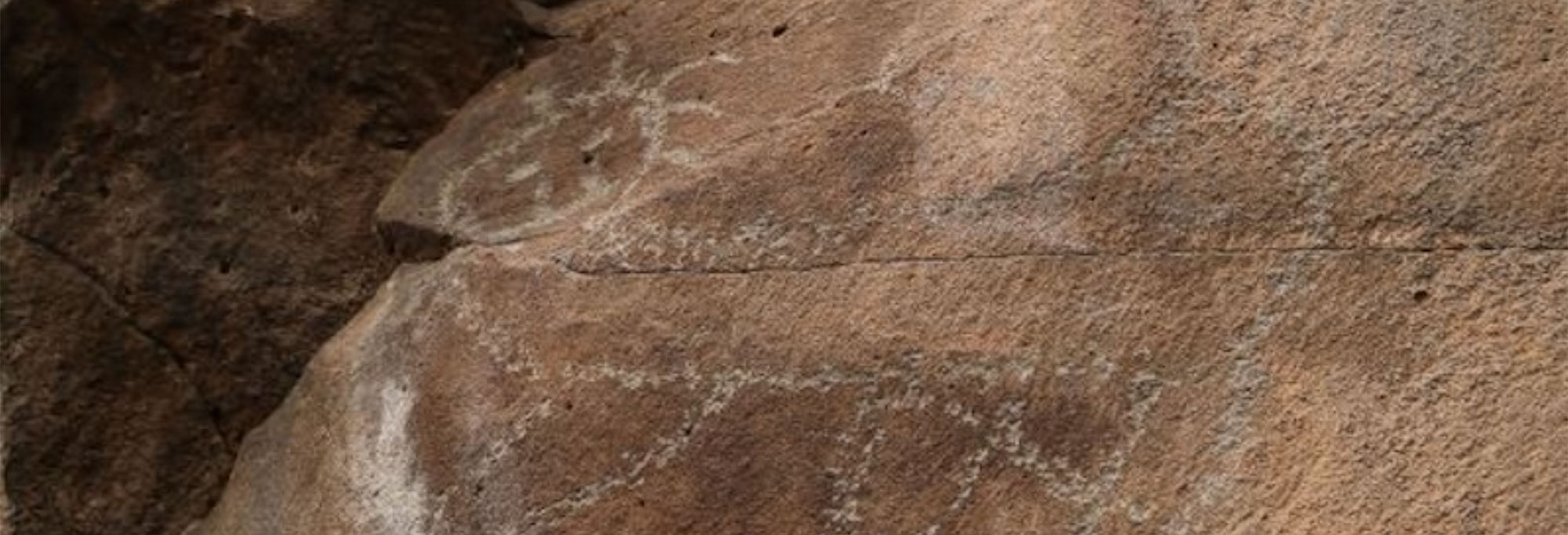
CANBERRA, AUSTRALIA—ABC News Australia reports that a survey of carvings on boab trees in northern Australia’s remote Tanami Desert has been conducted by a team of researchers led by traditional land owners and Sue O’Connor of Australian National University. The size of the boab trunks indicates that they are hundreds of years old. Many of the dendroglyphs are snakes, some of which are coiled, while others are wrapped around the trees. These snakes relate to the local King Brown Snake or Lingka Dreaming, explained traditional owner Brenda Garstone, and the story of the creation of the landscape. Other images include emu tracks and various shapes. The researchers recorded the carvings with thousands of photographs, and will create 3-D models of them using photogrammetry. O’Connor pointed out that stone artifacts used for seed grinding were found at the bases of the carved trees. The huge trunks would have offered shaded places to camp, she concluded. Read the original scholarly article about this research in Antiquity. To read about rock art in Arnhem Land that depicts ancestral Aboriginal creation stories, go to "Letter from Australia: Where the World Was Born."
Researchers Return to Bronze Age Site in Poland
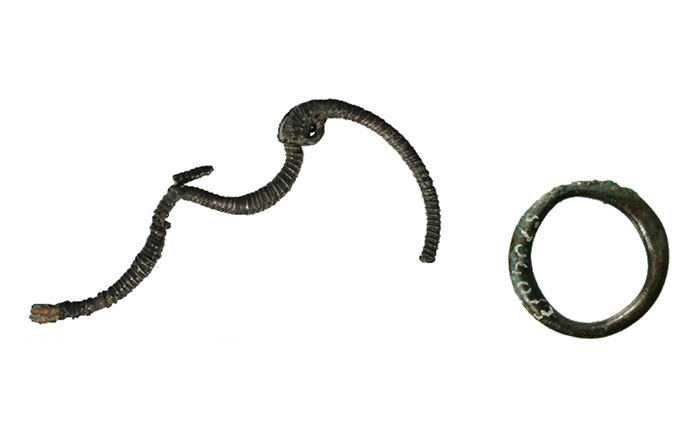
LUBLIN, POLAND—Science in Poland reports that Marcin Maciejewski of Maria Curie-Skłodowska University and his colleagues found a human skull, pottery, a cow skull, and other animal bones arranged in anatomical order in an embankment in west-central Poland where bronze axes, necklaces, bracelets, and a pin dated to about 750 B.C. were unearthed in 1943. Maciejewski suggests that the bronze objects had been buried in the embankment as a symbolic act, perhaps to mark a boundary and sanctify it. The embankment was later covered by a mound of stones, he added. Tools that may have been used to shape the stones were also recovered. To read about a Bronze Age cemetery of the Lusatian culture, go to "World Roundup: Poland."
Possible Irish Sweathouse Unearthed in Australia
ADELAIDE, AUSTRALIA—ABC News Australia reports that Susan Arthure of Flinders University has investigated Baker’s Flat, the site of a clachan, or settlement, inhabited by as many as 500 Irish immigrants who fled the Great Famine of the mid-nineteenth century. “The people of Baker’s Flat were predominantly poor and Catholic, and at that time in South Australia they weren’t particularly well-favored,” Arthure said. She has uncovered traces of cottages that had been whitewashed and thatched, and a round structure that she at first thought might have been used for making whitewash. But she found no evidence of burning or preparing lime, the basic ingredient in whitewash, in or around the building. A road running close to the building makes it unlikely to have been used to distill illegal whiskey, she added. An archaeologist in Ireland then suggested that the structure may have served as a sweathouse, a semi-subterranean, beehive-shaped building where arthritic pains and fevers were treated. “Sweathouses were very common in Ireland up until probably famine times,” Arthure said. “What is really exciting about the one here at Baker’s Flat is that we can look not only at how people were following the same traditions, but how they were adapting,” she concluded. To read about a mid-nineteenth century prison in Cork Harbor, go to "Letter from Ireland: The Sorrows of Spike Island."
More Remains of Sacrificed Children Uncovered in Peru
HUANCHACO, PERU—Live Science reports that the remains of an additional 76 children have been uncovered at the coastal Chimu site of Pampa la Cruz. According to excavation director Gabriel Prieto of the University of Florida, clean cuts across the sternums of all 76 skeletons suggest that the children’s rib cages had been opened, possibly to extract their hearts. The children’s bodies were buried in an extended position, with the feet toward the east, on top of an artificial mound placed near agricultural fields and an artificial irrigation system. The sacrifices, Prieto surmised, may have been intended to “sanctify” the project. In all, the remains of 323 sacrificed children have been uncovered at Pampa la Cruz, and hundreds more are likely to be found in the area, he added. Prieto and his colleagues have requested permission from Peru’s Ministry of Culture to take samples of the bones abroad for further testing and dating. Other skeletons unearthed at the site have been dated to between A.D. 1100 and 1200, when the Chimu people flourished in the region. To read about shark burials uncovered at Pampa la Cruz, go to "Remembering the Shark Hunters."
Scotland’s First Farmers Adapted to Changing Soil Conditions
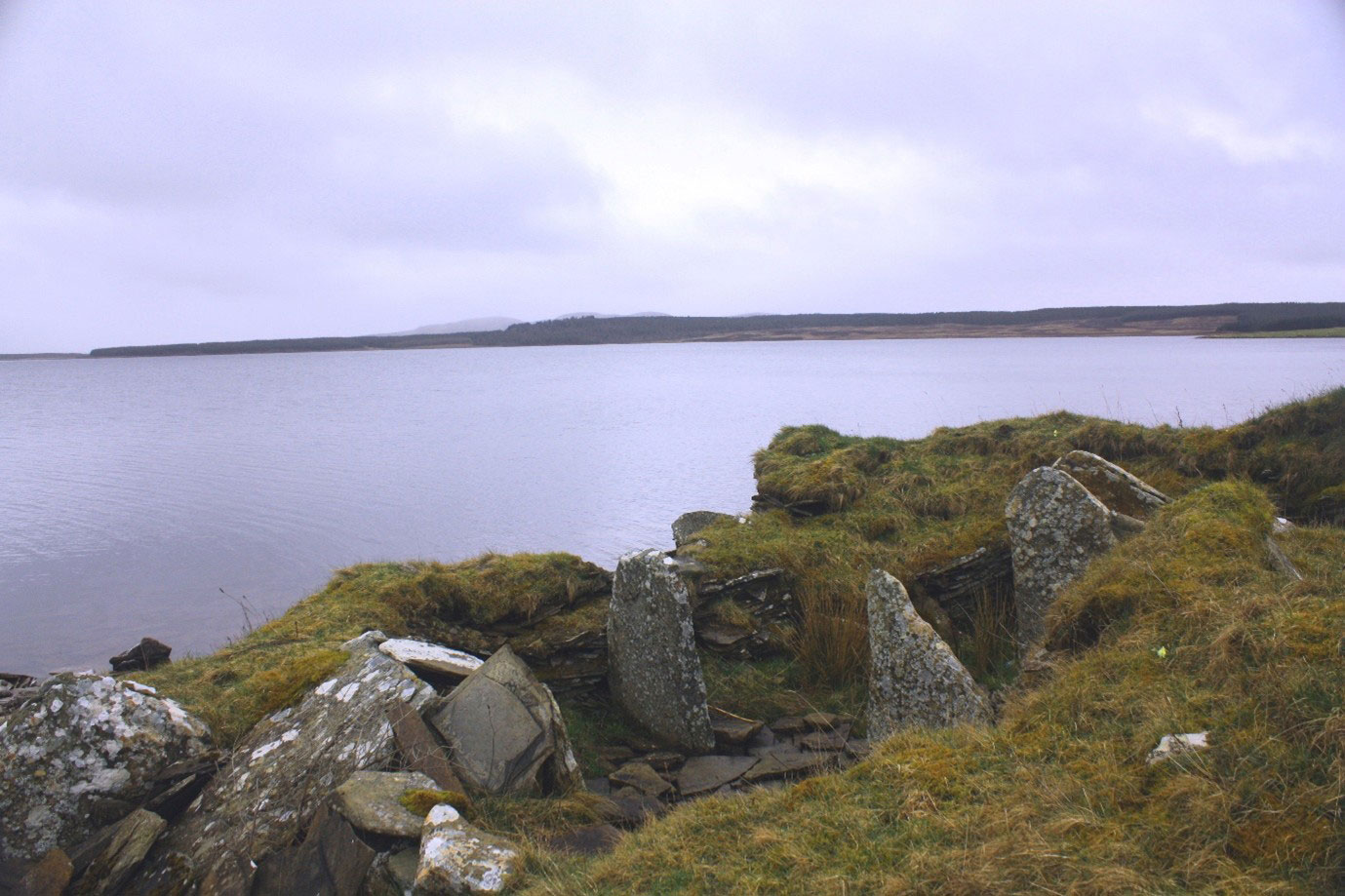
ABERDEENSHIRE, SCOTLAND—According to a statement released by Antiquity, stable isotope analysis of grain recovered from Balbridie, a Neolithic site in eastern Scotland, indicates that early farmers did not need to fertilize their fields with manure. Rosie Bishop of the University of Stavanger said that even though the grains had very low nitrogen levels, they were large and plentiful, reflecting the first phase of farming when the soils were productive without the need for added nutrients. In contrast, it is common to find evidence for the addition of manure to soils at early farm sites in England and in mainland Europe, Bishop explained. Evidence for the addition of manure was also detected at a farm site of the same age located to the south of Balbridie. By 3300 to 2400 B.C., the use of manure became the norm in Scotland, Bishop said, as Neolithic farmers established permanent fields. Read the original scholarly article about this research in Antiquity. To read about a ceremonial center on the Scottish archipelago of Orkney, go to "Neolithic Europe's Remote Heart."
Blue Fibers Found in Dental Calculus of Maya Sacrifice Victims
LOS ANGELES, CALIFORNIA—Analysis of the remains of more than 100 sacrifice victims who were buried in Belize’s Midnight Terror Cave during the Maya Classic Period (A.D. 250 to 925) has detected blue fibers clinging to dental plaque in the mouths of two of the dead, according to a Live Science report. Archaeologist Amy Chan said that a similar “Maya blue” pigment has been found at other sites, where it may have been used in ceremonies to paint the bodies of sacrificial victims. Blue fibers have also been recovered from an agave-based alcoholic beverage found in burials at Mexico’s ancient city of Teotihuacan. The blue fibers found in the dental calculus may have been left behind by blue gags left in the mouths of sacrificial victims over an extended period of time, Chan suggests, although the rate at which plaque forms and hardens into dental calculus is not known. Further study is required to understand where the blue fibers originated, Chan and her colleagues concluded. Read the original scholarly article about this research in International Journal of Osteoarchaeology. To read about an ancient Maya city on the border between Belize and Guatemala, go to "Off the Grid: El Pilar, Belize."
Medieval Cemetery Discovered in Wales
HAVERFORDWEST, WALES—BBC News reports that the remains of more than 240 adults and children have been discovered on a building site in Wales. The site includes the ruins of what is likely St. Saviour’s Priory, which was founded by Dominican Christian monks in A.D. 1256, according to Andrew Shobbrook of Dyfed Archaeological Trust. The priory included dormitories, stables, a hospital, and scriptoriums, in addition to the cemetery, which may have been in use into the early eighteenth century. “It’s quite a prestigious place to be buried,” Shobbrook explained. “You have a range of people, from the wealthy to general townsfolk.” Some of the dead had suffered head wounds that could have been caused by arrows or musket balls. They may have died fighting English occupation in the 1405 siege led by Owain Glyndŵr, the last native Welsh person to hold the title Prince of Wales, Shobbrook added. The remains will be studied and then reburied. To read about a pendant found in western Wales that was a personal symbol of faith during the Tudor period, go to "Heart of the Matter."
Advertisement