Subscribe to Archaeology
Archaeological Headlines By JESSICA E. SARACENI
Wednesday, October 5

How Did Vikings Make Glass Beads?

AARHUS, DENMARK—According to a statement released by Aarhus University, Gry Hoffmann Barfod and Søren Sindbæk of Aarhus University and Claus Feveile of the Museum of Southwest Jutland analyzed the composition of white beads recovered from an early workshop at the Viking trade center known as Ribe. The study has revealed how the beads were manufactured at a time when glass was a scarce commodity. First, the gold on gilded glass cubes taken from Roman and Byzantine mosaics was salvaged, and then the glass was melted at low temperature. Stirring this molten glass trapped air in the form of bubbles, which turned it opaque. The white glass was finally wrapped around an iron mandrel to form beads. It had been previously thought that Viking craftsmen relied upon white tesserae to produces these beads, but tiny drops of gold trapped in air holes, and the lack of chemical color tracers, offered clues to the process. Traces of gold were also found in deep blue transparent beads found in the same Viking workshop. These beads were made from a mix of blue and gilded mosaic tesserae, the researchers explained, adding that Viking artisans appear to have chosen to work with the high-quality tesserae rather than recycling scraps of heavily reused and contaminated Roman glass. To read about a figurine workshop unearthed at Ribe, go to "Viking Roles."

East Anglian Royal Hall Uncovered in England

RENDLESHAM, ENGLAND—BBC News reports that traces of a royal hall estimated to be 1,400 years old were discovered in a medieval settlement in eastern England this past summer by a team of researchers and volunteers under the direction of archaeologist Christopher Scull. The structure, which was recorded in the writings of the medieval historian known as the Venerable Bede, measured about 75 feet long and 33 feet wide, and was surrounded by a ditch. “Only at Rendlesham do we have the wider settlement and landscape context of an early English royal center, together with an assemblage of metal work that illuminates the lives and activities of its inhabitants across social range,” Scull said. Bones of cows and pigs, jewelry, pottery, and glass fragments have been recovered from the ditch, he added. For more on archaeology in Rendlesham, go to "The Ongoing Saga of Sutton Hoo."

Traces of Roman Pier Found Off Croatia’s Coast

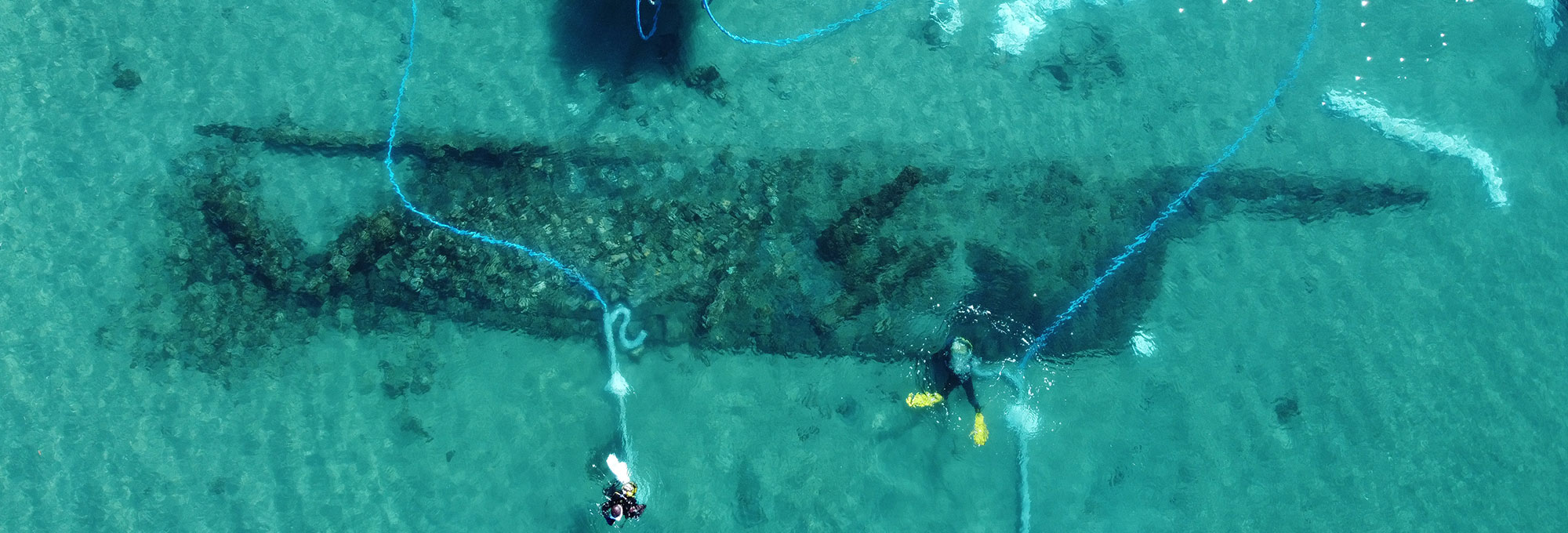
PULA, CROATIA—Stones from a Roman jetty, olive pits, and amphora fragments have been discovered under 10 feet of water in Barbariga Bay, according to a Total Croatia News report. Some 2,000 years ago, the pier measured about 200 feet long and was used to ship oil from a large olive mill situated along the coast, according to underwater archaeologist Ida Koncani Uhač of the Archaeological Museum of Istria. First-century A.D. Roman author Pliny the Elder wrote that oil from this mill was the second best in quality in the entire Roman Empire, she added. The oil would have been stored in amphoras that were also manufactured in the Istria peninsula. To read about the Romans' destruction of olive groves at the ancient city of Zita in present-day Tunisia, go to "Oliveopolis."

Pacific Population Decline After European Contact Investigated

CANBERRA, AUSTRALIA—According to a statement released by Australian National University, population decline in Pacific Island nations after contact with Europeans was more severe than previously thought. Phillip Parton and Geoffrey Clark used archaeological data and aerial laser scanning of residential sites on Tongatapu, the main island of Tonga, to estimate the former population, and found that there were between 50,000 and 60,000 people living on the island prior to contact with Europeans. Over a period of about 50 years, that number dropped to just 10,000 people, Parton explained. He also checked this estimate against data collected by missionaries and traders. “Obviously, this shows a big reassessment of the impact of globalization in the nineteenth century,” he said. To read about the arrival of the Lapita people to Tonga, go to "World Roundup: Tonga."

Tuesday, October 4

Footprints Reflect Ecosystem Change in Prehistoric England

LIVERPOOL, ENGLAND—BBC News reports that an 8,200-year-old human footprint has been identified among hundreds of animal footprints in tidal mud flats on the coast of northwest England. Alison Burns of the University of Manchester said that the oldest prints among the 31 footprint beds on the beach are almost 9,000 years old, while the youngest are about 1,000 years old, based upon radiocarbon dating of seeds recovered from the different layers. Jamie Woodward of the University of Manchester said that many different animals, such as aurochs, red deer, roe, wolves, and lynx lived in the landscape until about 5,500 years ago, when many human and dog footprints appeared. This change reflects the rise in sea levels and the arrival of agriculture, he explained. The 8,200-year-old human print is thought to belong to a young man, based upon its size and shape. A protrusion on the little toe indicates that he had a bunion, Burns added. To read about nearly one-million-year-old hominin footprints discovered on the English coast, go to "England's Oldest Footprints."

Possible Bronze Age Game Pieces Analyzed

BRISTOL, ENGLAND—According to a statement released by the University of Bristol, Christianne Fernée and Konstantinos Trimmis suggest that small stone spheres and stone slabs with shallow cup marks found at settlements across the Aegean and Mediterranean regions could be pieces to a Bronze Age game. The researchers examined more than 700 stones unearthed at the site of Akrotiri, which is located on the Greek island of Santorini. These spheres are made of different materials and range in age from 4,500 to 3,600 years old. First, Fernée and Trimmis used machine learning to sort the stones into groups, finding they could be split into two groups based on their size. If they had been used as part of a counting system, Fernée explained, the researchers expect that the sorting would have produced more groups. They will next investigate possible clusters in the cup marks on the stone slabs, and associations between the spheres and slabs at some sites. Artificial intelligence may even help them to determine how such a game could have been played. To read about monkey paintings from Akrotiri, go to "A Barrel of Bronze Age Monkeys."

Nobel Prize Awarded for Development of Paleogenomics

STOCKHOLM, SWEDEN—Svante Pääbo of the Max Planck Institute for Evolutionary Anthropology has been awarded the Nobel Prize in Physiology or Medicine for his work to map the Neanderthal genome and identify Denisovans, according to a BBC News report. Pääbo first sequenced DNA from a 40,000-year-old piece of bone, showing that Neanderthals were a distinct species from modern humans. Then, he sequenced a sample of DNA extracted from a finger bone recovered from Siberia’s Denisova Cave, revealing that it came from a previously unknown hominin now known as the Denisovans. The prize committee explained that Pääbo’s work has helped researchers to explore human evolutionary history, human migration and interactions with other hominins, and what makes us uniquely human. “I was very surprised and overwhelmed, I had not expected this,” Pääbo said. To read more about his pioneering research, go to "Neanderthal Genome," one of ARCHAEOLOGY's Top 10 Discoveries of the Decade.

Seventh-Century Gold Coins Discovered in Golan Heights

GOLAN HEIGHTS—BBC News reports that 44 gold coins were found in the ancient wall of a residential building at Banias, a Byzantine site in the Golan Heights. The coins are thought to have been hidden during the Muslim conquest of the area in A.D. 635. “We can imagine the owner concealing his fortune in the threat of war, hoping to return one day to retrieve his property,” said Yoav Lerer of the Israel Antiquities Authority (IAA). Some of the coins were minted during the reign of the emperor Phocas, between 602 and 610, but must of them date to the reign of his successor, Heraclius (r. A.D. 610–641), added IAA numismatist Gabriela Bijovsky. To read about tenth-century Islamic coins unearthed in Jerusalem, go to "Money Talks."   

Monday, October 3

Paleolithic People Hunted and Fished in Norway’s Mountains

OSLO, NORWAY—Science Norway reports that poles from ancient fish traps were spotted this past summer in Lake Tesse, which is located in the mountains of southern Norway’s Jotunheimen National Park. One of the poles has been dated to 7,000 years ago, according to researchers from the Museum of Cultural History in Oslo. The arrangement of the poles suggests that there were at least three trapping chambers in the lake. Each chamber had guiding fences to lead the fish into the traps, where they could be collected from a boat or a wader. Additional study of the poles could reveal how many years the traps were used, how often they were repaired, and what time of year the repairs took place. Traces of Paleolithic settlements and evidence of reindeer hunting have been found close to the lake. To read about more finds from the Jotunheimen Mountains, go to "Letter from Norway: The Big Melt."

Advertisement