Subscribe to Archaeology
Archaeological Headlines By JESSICA E. SARACENI
Friday, September 30

Face of Paleolithic Woman Reconstructed

MLADEČ, CZECH REPUBLIC—According to a Live Science report, the face of a person whose remains were discovered in 1881 in a cave in the Czech Republic has been reconstructed from computed tomography scans of the skull, which is known as Mladeč 1. The individual is estimated to have been about 17 years old at the time of death sometime during the Upper Paleolithic period, between 43,000 and 26,000 years ago. “When the skull was analyzed individually, the features pointed to a male,” said team member and graphics expert Cicero Moraes. “But when later studies compared the skull with others found at the site, the evidence pointed to a female,” he said. Because the lower jaw is missing, data taken from some 200 CT scans of modern human jaws was used to project missing areas of the face. Soft tissue markers were then added to the digital image of the skull to create a neutral expression. To read about the diet of people who lived at the Upper Paleolithic settlement of Predmostí, go to "World Roundup: Czech Republic."

Burial Bundles Uncovered in Peru

LIMA, PERU—Reuters reports that workers constructing a gas pipeline discovered a series of burial bundles in the dry, sandy soil to the north of Lima’s metropolitan area. The bundles held the remains of adults and children, according to project archaeologist Roberto Quispe. Archaeologist Cecelia Camargo added that the oldest burials are thought to belong to the Huaura culture, and date to about 800 years ago, while other burials may belong to the Chancay culture, and date to about 600 years ago. Some of the tombs held pottery and clay figurines that may represent goddesses. To read about an unusual way of honoring the dead in ancient Peru, go to "Dignity of the Dead."

Unusual Building Explored at Çatalhöyük

POZNAŃ, POLAND—Science in Poland reports that Arkadiusz Marciniak of Adam Mickiewicz University and his colleagues have examined an unusual 8,000-year-old building at Çatalhöyük, a Neolithic city in southern Anatolia that was inhabited for some 1,200 years. “We know that the building was used when Çatalhöyük was no longer a mega-settlement with thousands of residents,” Marciniak explained. The large structure has 12 platforms covered with clay, nine of which are located along the building’s walls. Two pilasters flanked by attachment points for antlers decorate the edge of the eastern platform. The western wall was covered with a painting, and a large furnace was placed by the southern wall. A hearth was found in the center of the building. Marciniak thinks the building, which is larger than other structures dated to the same period, may be a sign of social changes that took place during the city’s last years. People could have also returned to the place where their ancestors had lived, and gathered around the hearth, he added. Further excavation could reveal burials, since burials have been found under many of the residences at Çatalhöyük. To read about houses at Çatalhöyük, go to "Around the World: Turkey."

Thursday, September 29

Mercury Levels Measured at Ancient Maya Sites

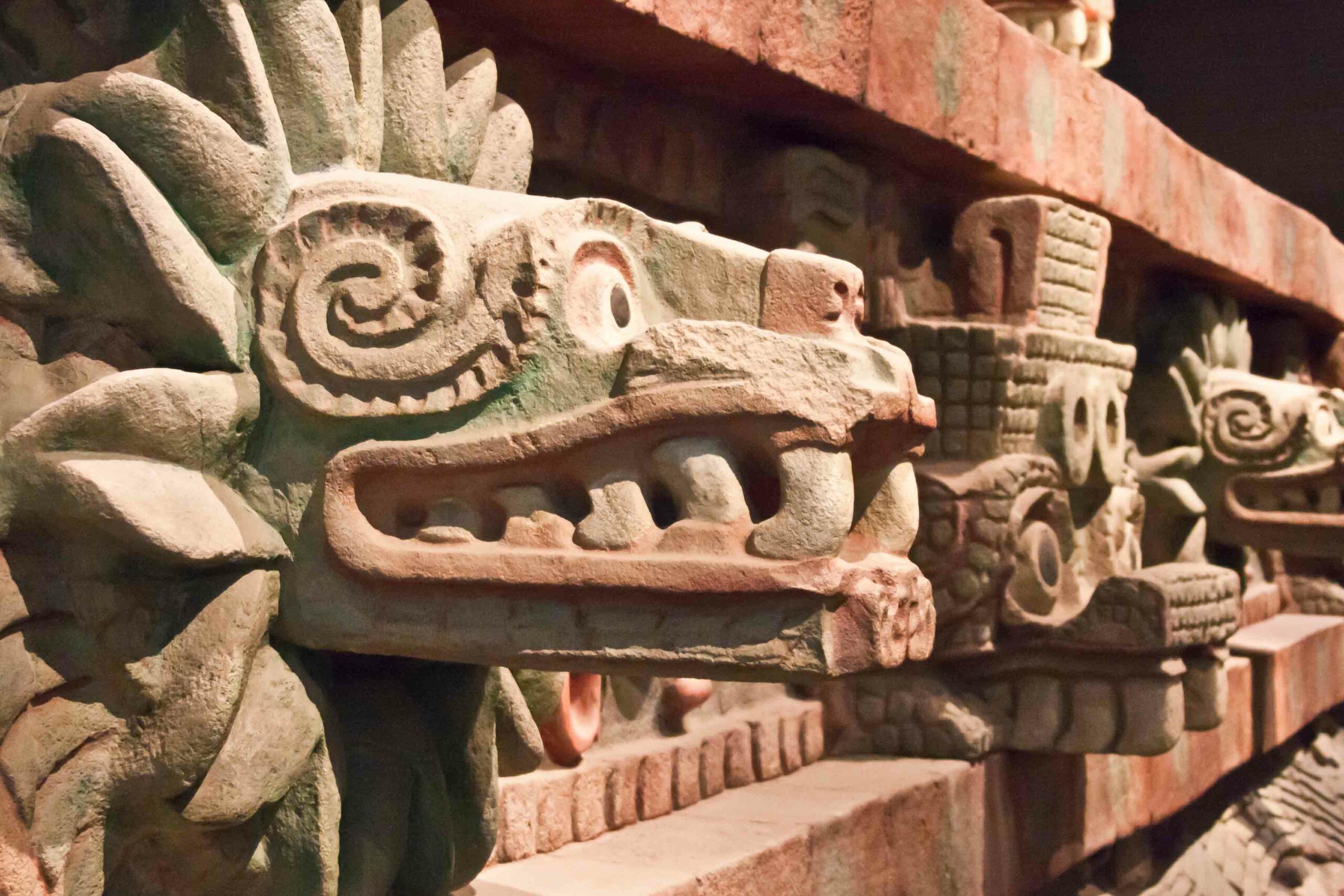
BRISBANE, AUSTRALIA—A recent study of mercury pollution in the ancient Maya world conducted by Duncan Cook of Australian Catholic University and his colleagues detected contamination in at least one location at seven out of ten Maya cities, according to a Cosmos Magazine report. Most of the contamination has been dated to the Late Classic period, from about A.D. 600 to 900. All of these sites were abandoned by the tenth century, Cook explained. “Our review shows that numerous Maya sites have total mercury levels that, if found in a playground or a building site, would be cause for concern,” he said. The researchers do not yet know how the contamination occurred, although vessels containing pure liquid mercury have been recovered at several Maya sites. Mercury is also found in the red mineral cinnabar, which was often used as a pigment. “The brilliant red pigment of cinnabar was an invaluable and sacred substance, but unbeknownst to them it was also deadly and its legacy persists in soils and sediments around ancient Maya sites,” added team member Nicholas Dunning of the University of Cincinnati. Further study could connect high mercury levels in the soil to the presence of mercury in human remains at those sites, Cook concluded. Read the original scholarly article about this research in Frontiers in Environmental Science. To read about liquid mercury found beneath Teotihuacan's Feathered Serpent Pyramid, go to "Mythological Mercury Pool," one of ARCHAEOLOGY's Top 10 Discoveries of 2015.

U.S. Repatriates Artifacts to Colombia

WASHINGTON, D.C.—According to a News 360 report, the U.S. has repatriated 274 artifacts to Colombia. Many of them belonged to a U.S. citizen who contacted the Colombian Embassy in 2019. Her husband collected the objects, which are thought to have come from the regions Tumaco-La Tolita, Quimbaya, Tayrona, Calima, Sinü, and Nariño, while living in Cali in the 1970s. The Colombian Ministry of Foreign Affairs said that the repatriated objects include cups, pots, alcarrazas, spindle whorls, seals, necklaces, molds, ocarinas, vessels, anthropomorphic figures, rollers, pendants, and shells. To read about rose gold jewelry made by first-millennium B.C. Indigenous people in northern Colombia, go to "The Pink Standard."

SS Mesaba Located in Irish Sea

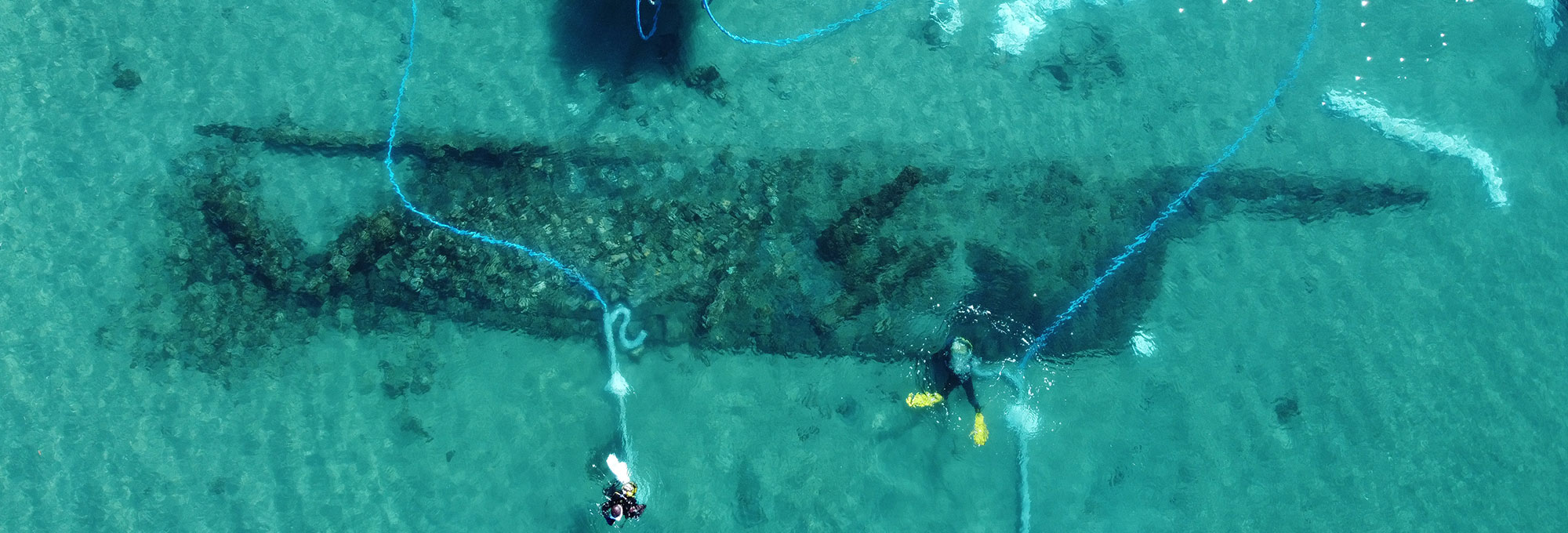
BANGOR, WALES—According to a statement released by Bangor University, the wreckage of the merchant steamship SS Mesaba has been identified in the Irish Sea by researchers led by Michael Roberts of Bangor University’s School of Ocean Sciences. Roberts and his colleagues scanned the floor of the Irish Sea with multi-beam sonar, and then compared the resulting detailed images with data maintained by the UK Hydrographic Office, leading to the identification of more than 100 shipwrecks. The Mesaba is remembered for sending a radio warning to RMS Titanic of the presence of an iceberg in its path. Although the message was received by Titanic, it never reached the bridge. The Mesaba was eventually torpedoed while in a convoy in 1918. For more on Titanic, go to "History's 10 Greatest Wrecks...RMS Titanic."

Possible 10,000-Year-Old Baby Sling Identified

MONTREAL, CANADA—According to a statement released by the University of Montreal, a team of researchers led by Claudine Gravel-Miguel of Arizona State University and Julien Riel-Salvatore of the University of Montreal has found possible evidence for the use of a baby sling some 10,000 years ago. They created a 3-D photogrammetry model of the burial of a 40- to 50-day-old baby unearthed in the cave site of Arma Veirana, which is located in Liguria, Italy, and analyzed the more than 70 small perforated marine shells and four big perforated bivalve pendants recovered from it. The study suggests that the beads, many of which showed heavy signs of use, had been sewn onto a piece of leather or cloth that was wrapped around the baby, who is now known as Neve. The wear on the beads indicates that they may have been worn by someone else before they were handed down to Neve, Gravel-Miguel said. “Given the effort needed to create and use beads over time, it is interesting that the community decided to part with these beads in the burial of such a young individual,” she said. Observations of modern hunter-gatherers, however, suggest that the carrier’s decorations may have been intended to protect a baby from harm or evil. When Neve died, it may have been decided to bury the carrier with her rather than reuse it, added Riel-Salvatore. Read the original scholarly article about this research in the Journal of Archaeological Method and Theory. For more on this burial, go to "Around the World: Italy."

Wednesday, September 28

Medieval Silver Coins Found in Ireland

CORK, IRELAND—The Irish Examiner reports that archaeologist Tony Miller is conducting excavations at the site of Carrignacurra Castle, a defensive tower house built on a high rock outcrop on the banks of the River Lee in southern Ireland in the late sixteenth century. “During the excavation of the ground floor, a cobbled floor was uncovered in one corner as well as a rectangular base for storage bins or a workbench against the northern wall,” Miller said. He has also found a clay pipe manufactured in Bristol, England, which may have been left behind by English troops during Oliver Cromwell’s conquest of Ireland in the seventeenth century. Pottery, animal bones, a small bone bead have also been uncovered. The unused lead musket balls that have been found may have been produced on site, he added. Two silver coins predating the construction of the tower were also recovered: a groat featuring Henry III dated to 1270, and a coin bearing the image of Edward IV dated to the 1470s. To read about a kingdom on a tiny Irish island, go to "Inside a Medieval Gaelic Castle."

Unusual Burials Unearthed in Turkey’s Ancient Port of Anemurium

MERSIN, TURKEY—The remains of an additional four people have recently been uncovered in the ancient port city of Anemurium, which is located in southern Turkey, by researchers led by archaeologist Mehmet Tekocak of Selcuk University, according to a Hurriyet Daily News report. The skeletons, including the bones of a newborn found in an amphora, were found in an area of the city thought to have been a colonnaded street. Tekocak explained that a total of seven sets of human remains have been found in this area, and it is the first time a child’s remains have been recovered from an amphora at the site. “Adult individuals were very carelessly buried directly in the ground. But they created a very special area for the baby,” he said. Tekocak and his colleagues think there may have been a church and churchyard situated near the street that has not yet been identified. To read about another recent archaeological discovery in Turkey, go to "Around the World: Turkey."

Settlement Discovered Near Caliph’s Palace Site in Israel

MAINZ, GERMANY—According to a statement released by the Johannes Gutenberg University of Mainz, a team of researchers conducting geomagnetic surveys found traces of a settlement near the site of the palace of Khirbat al-Minya on the shores of the Sea of Galilee in northern Israel. It had been previously thought that the land was unoccupied when the caliph Walid began construction of the palace, mosque, and gateway tower in the early eighth century. Test pits in the settlement revealed structures made of basalt with plastered walls, mosaic floors, and a water cistern. Images on the mosaics include plants with long, curved stems resembling those found in mosaics depicting scenes on the Nile that date to the fifth and sixth centuries A.D. Ceramics in the settlement have also been dated from the fifth to seventh centuries. To read about an Islamic desert castle in Palestine, go to "Expanding the Story."

Documenting Australia’s Marra Wonga Rock Art

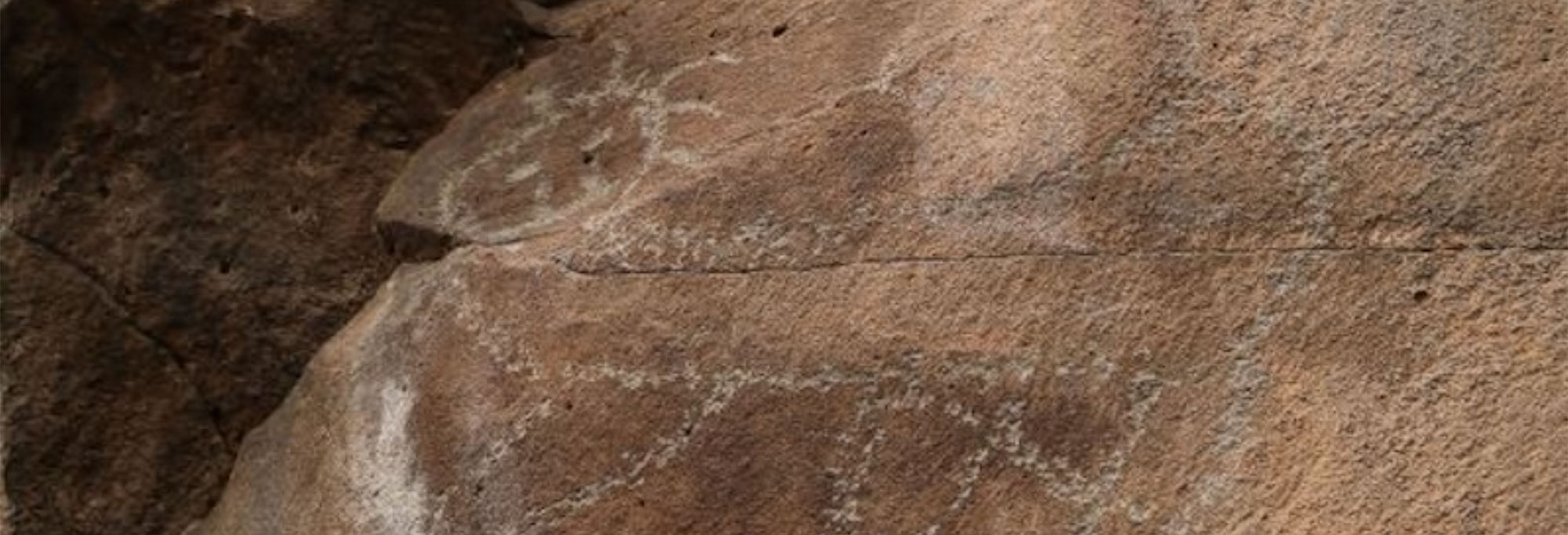
QUEENSLAND, AUSTRALIA—According to a Cosmos Magazine report, Iningai Traditional Owners working with researchers from Griffith University are documenting and shedding light on the more than 15,000 petroglyphs within the Marra Wonga rock shelter, which is located in northeastern Australia. Paul Tacon of Griffith University said that the rock art has been interpreted as a Seven Sisters Dreaming story. Seven of the petroglyphs are large star-like designs with central engraved pits. Large snake-like designs run across and through other images, including animal tracks; lines, grooves, and drilled holes; more than 100 hand-related images; stencils of boomerangs, a digging stick, tips, and a possible ring pad; and a phallus. On the floor of the shelter, there is a cluster of human foot-shaped petroglyphs, some of which have six or more toes. Such stories, in which seven sisters are chased by a man or several men, are known all over the world, and are connected to the Pleiades star cluster and the Orion constellation. The Marra Wonga petroglyphs, Tacon explained, are related to Wattanuri, an ancestral being, who pursues the Seven Sisters. “There are plans to do some excavations near the site in the future and that should allow us to determine the length of occupation right at that site, and there is a possibility that some mud wasp nests overtop of some engraved figures could be sampled for dating,” Tacon said. Read the original scholarly article about this research in Australian Archaeology. To read about rock art that depict how Aboriginal ancestors envisioned creation, go to "Letter from Australia: Where the World Was Born."

Advertisement