Subscribe to Archaeology
Archaeological Headlines By JESSICA E. SARACENI
Tuesday, September 27

Study Suggests Cacao Consumption Not Limited to Maya Elites

SANTA BARBARA, CALIFORNIA—Traces of cacao (Theobroma cacao) have been detected on pottery fragments recovered from different areas of the Maya site of El Pilar, which suggests that it was consumed at every level of society between A.D. 600 and 900, according to a Science News report. Cacao is used to produce chocolate, and in ancient Maya society was linked to Hun Hunahpu, the maize god. Anabel Ford of the University of California, Santa Barbara, and her colleagues found a chemical indicator for the presence of cacao on more than half of 54 fragments of jars, mixing bowls, serving plates, and possible drinking vessels unearthed in residential and ceremonial civic areas in the city center, the foothills, and upland areas of the ancient city, which is situated on the border between Guatemala and Belize. “Now we know that the rituals the elite depict with cacao were likely played out, like Thanksgiving, like any other ritual, by everyone,” Ford said. Researchers can next explore the question of who grew cacao and managed its distribution, she added. Read the original scholarly article about this research in Proceedings of the National Academy of Sciences of the United States of America. For more on Maya cultivation of cacao, go to "Around the World: Mexico."

Monday, September 26

Genome Study Offers Clues to Anglo-Saxon Migration

HUDDERSFIELD, ENGLAND—According to a statement released by the University of Huddersfield, a team of researchers from the Max Planck Institute for Evolutionary Anthropology, the University of Central Lancashire, and the University of Huddersfield analyzed the genomes of more than 400 people who lived in Britain, Ireland, German, Denmark, and the Netherlands, and determined that there was a wave of migration from the North Sea region into eastern England during the Anglo-Saxon period, beginning some 1,500 years ago. The study suggests that as much as three quarters of eastern England’s early medieval population had ties to continental European countries bordering the North Sea. And analysis of mitochondrial DNA, which is inherited only through the maternal line, indicates that women, and likely whole families, had made the trip. By region, the DNA analysis indicates that residents of North Yorkshire were descended mostly from the North Sea migrants, while Britons in the southwest had very few ancestors from the continent. Team member Ceiridwen Edwards said that most of the Anglo-Saxon sites in eastern and southern England, however, seem to have more mixed ancestry. The people buried in the cemetery at Apple Down, in Sussex, for example, had 50 percent continental ancestry, but there were distinct local and immigrant burial styles, she explained. To read about a Roman building complex unearthed in North Yorkshire, go to "Leisure Seekers."

19th-Century Artifacts Found in New Zealand

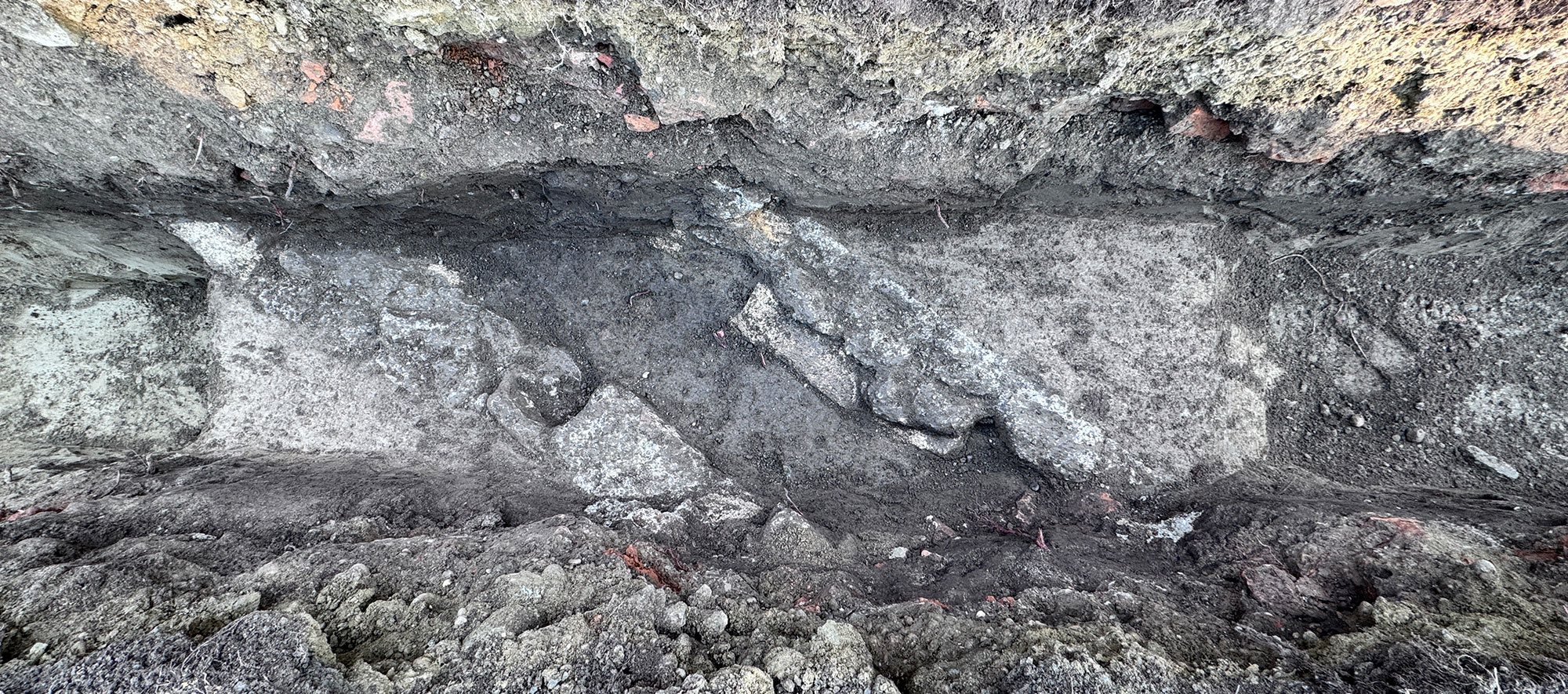
CHRISTCHURCH, NEW ZEALAND—According to a Stuff report, an archaeological investigation conducted ahead of a large-scale reconstruction project over three city blocks in central Christchurch has uncovered a large collection of nineteenth-century artifacts, including a shoe, a Chilean peso, clay pipes, traces of a vegetable garden, earthenware drainage pipes, bottles, pots for toothpaste and cold cream, house pilings, and remnants of brick fire places. Archaeologist Clara Watson explained that the area under excavation had been used as a parking lot and was not heavily disturbed before the 2011 earthquake that struck the city. The researchers have no idea how the Chilean peso ended up in New Zealand, she added. To read about another recent discovery in Christchurch, go to "Around the World: New Zealand."

Second Ancient Native American Canoe Discovered in Wisconsin

MADISON, WISCONSIN—According to a statement released by the Wisconsin Historical Society, a second ancient canoe has been recovered from Lake Mendota. Last year, a 1,200-year-old canoe was discovered in the lake’s mud by maritime archaeologist Tamara Thomsen while on a recreation dive. She found this canoe, which has been radiocarbon dated to 3,000 years ago, while diving this past spring. The vessel, carved from a single piece of white oak, measures about 14.5 feet long. “Since it was located within 100 yards of where the first canoe was found at the bottom of a drop-off in the lakebed, the find has prompted us to research fluctuating water levels and ancient shorelines to explore the possibility that the canoes were near what is now submerged village sites,” said state archaeologist James Skibo. The canoe will be cleaned and cared for by members of the Ho-Chunk Nation and the Bad River Tribe, in addition to the staff of the Wisconsin Historical Society, before it joins the 1,200-year-old canoe in the preservation process at Wisconsin’s State Archive Preservation Facility. To read about the discovery of the first canoe, go to "Gone Fishing."

Friday, September 23

Remains of Sacrificed Children Uncovered in Peru

TRUJILLO, PERU—Andina News Agency reports that the remains of an additional 76 children have been found at the Chimu site of Pampa la Cruz, which is located near Peru’s northern coastline. Twenty-five of the graves were found in Mound I, while the other 51 were uncovered in Mound II. In all, the remains of 302 children have been unearthed in the area. Archaeologist Gabriel Prieto of the University of Florida said radiocarbon dating suggests that the children were killed in six sacrificial events between about A.D. 1050 and 1500. Another burial in Mound I held the remains of five women seated in a circle. For more on the child burials at Pampa la Cruz, go to "Peruvian Mass Sacrifice," one of ARCHAEOLOGY's Top 10 Discoveries of 2019.

Gold Mask Found in Shang Dynasty Tomb in Central China

ZHENGZHOU, CHINA—A 3,000-year-old gold funeral mask has been recovered from a Shang Dynasty noble’s tomb in central China, according to a Live Science report. Huang Fucheng of the Zhengzhou Municipal Institute of Cultural Heritage and Archaeology said the mask measures about seven inches long and almost six inches wide, making it big enough to have covered an adult’s face. More than 200 artifacts, including ornate daggers, axes, wine vessels, smoking pipes, and goblets made of bronze and jade were also recovered from the tomb, which covers more than 108,000 square feet. Gold objects are rare at Shang Dynasty sites, and may indicate a link to another early Chinese state where gold was more common. “Where does the raw gold come from?” asked Chen Lüsheng of the National Museum of China. “Why did the tomb occupant choose to be buried with gold, while other top elites chose only bronzes and jades?” Gold has been found in small amounts in the region, he added, but it may have been imported as an exotic metal from the Yangtze River Valley to the south. To read about 2,000-year-old bronze mirrors found at a cemetery in Xi'an, China, go to "Mirror, Mirror."

Greek Coin Recovered in Croatia

ZAGREB, CROATIA—Total Croatia News reports that a Greek coin dated to the end of the fourth century B.C. was discovered by hikers on a forest road in eastern Croatia’s Papuk Mountain after a heavy rainfall. The silver drachma shows Zeus enthroned with a bird on one side, and bears an image of Alexander the Great on the other. Archaeologist Hrvoje Potrebica said it was probably minted in the city of Kolophon in Asia Minor. Pottery fragments were also found. A nearby settlement where approximately 500 people lived along a trade route has been dated to the seventh century B.C. “This shows continuity on the political, economic, and cultural scene of over 300 years, which few can boast of today, let alone back then,” Potrebica commented. To read about the search for Alexander's tomb, go to "In Search of History's Greatest Rulers: Alexander the Great, King of Macedon."

1,300-Year-Old Tomb of the “Lord of Huarmey” Excavated in Peru

HUARMEY, PERU—Live Science reports that researchers led by Miłosz Giersz of the University of Warsaw discovered a 1,300-year-old Wari tomb in a necropolis on Peru’s North Coast known as El Castillo de Huarmey. The tomb is thought to have belonged to a man who has been dubbed the “Lord of Huarmey,” although the remains of six other people were included in the burial. They are thought to have been buried at another site before they were reinterred in this tomb. The grave also held an abundance of gold and silver jewelry in various stages of completion, bronze tools, knives, axes, baskets, woven textiles, materials for making baskets, and wood and leather items. Giersz suggests that the tomb’s occupants may have been skilled craftspeople in addition to being members of the Wari elite. This tomb is located on top of a larger tomb Giersz and his colleagues discovered in 2012, which contained the remains of three high-status Wari women and 58 other people, some of whom may have been sacrificed. Giersz thinks the Castillo de Huarmey may have been an administrative center for the Wari Empire and a place of ancestor worship. For more on previous discoveries at the site, go to "Tomb of the Wari Queens."

Advertisement