Wooden Canoe Burial Discovered in Northern Patagonia
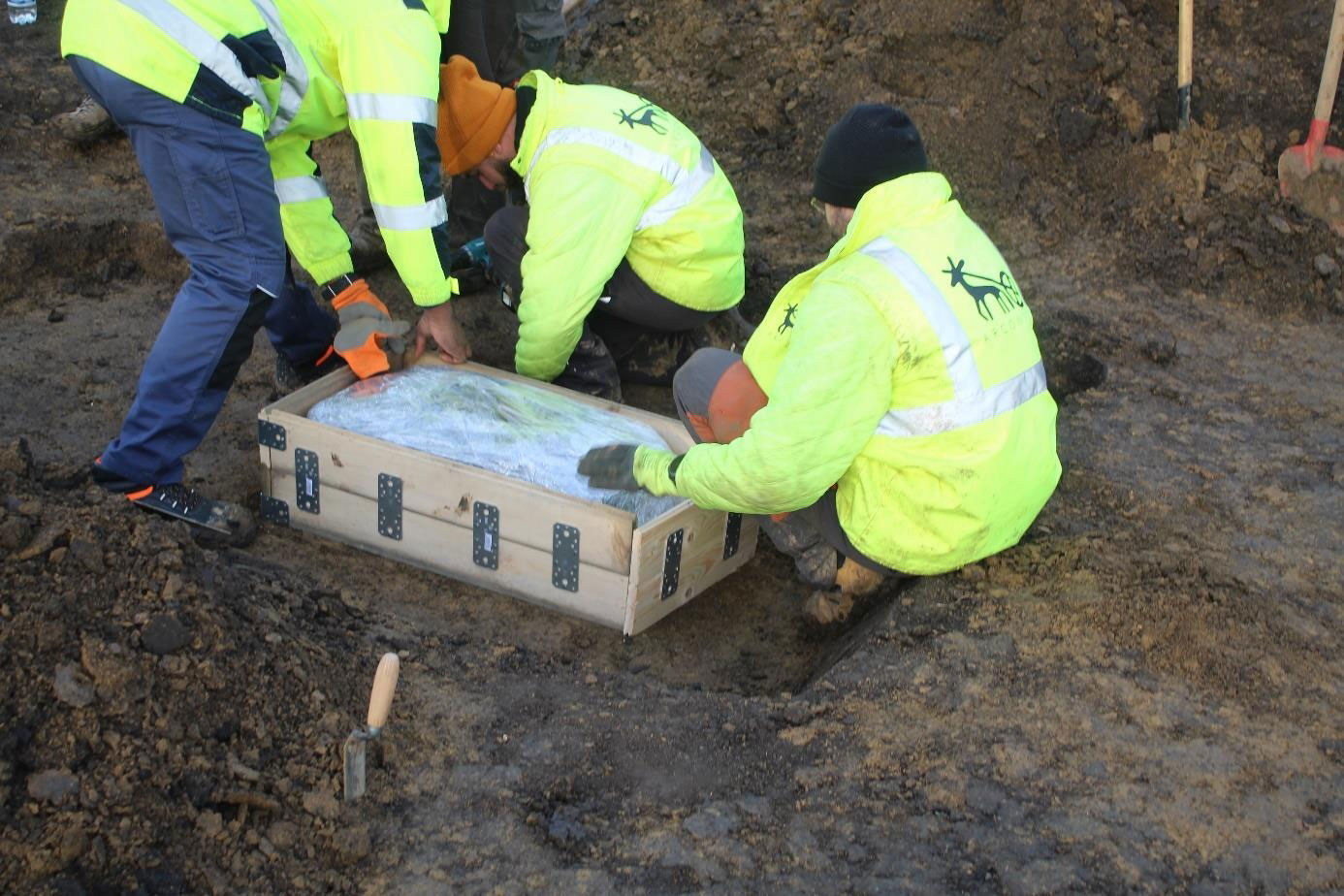
TEMUCO, CHILE—Live Science reports that Alberto Pérez of Temuco Catholic University and his colleagues have discovered the remains of a young Mapuche woman who was buried in a wampo, or ceremonial canoe, between 850 and 1,000 years ago at the Newen Antug archaeological site, which is located on what is now private land in western Argentina. Some scholars had previously suggested that this burial practice was used only after Spanish colonization, but Pérez argues that the wood rots rapidly in South America’s climate, leaving little direct evidence. “The previous evidence was important and was based on ethnographic data, but the evidence was indirect,” he explained. Only fragments of the canoe, made by hollowing out a single tree trunk with fire, remain in this grave. Analysis of the fragments indicates that they came from a single Chilean cedar. The woman’s body was set on a bed of freshwater clam shells, and its position, with the arms set over the torso and raised head and feet, indicate that she had been placed in a concave structure with thicker walls at its ends, such as the bow and stern of a canoe. A pottery jug decorated with white glaze and red geometric patterns had been placed by the woman’s head for her final journey. Read the original scholarly article about this research in PLOS ONE. To read about another recent discovery in Argentina, go to "Around the World: Argentina."
Early Modern Human Tool Workshop Investigated in Romania
LEIDEN, THE NETHERLANDS—According to a statement released by Leiden University, a possible stone projectile workshop has been uncovered at Româneşti, an early modern human site in western Romania. Wei Chu of the University of Leiden and his colleagues found highly standardized chipped stone bladelets, grindstones that may have been used to shape wooden shafts, and evidence for the use of fire at the site. They also determined that some of the materials unearthed at Româneşti originated more than 180 miles away. Microscopic analysis of the chipped stone bladelets indicates that most of them had not been used. Instead, the researchers suggest that they may have been manufactured at Româneşti and then transported somewhere else. Finally, fossils found nearby suggest that these early modern humans may have been mixing with Neanderthals. Read the original scholarly article about this research in Scientific Reports. To read about a fifth-millennium B.C. artifact unearthed in northeastern Romania, go to "Ancient Tattoos: Ceramic Female Figurine."
Cold Sore Virus Detected in Ancient Human Remains
TARTU, ESTONIA—According to a Nature News report, scientists have found DNA from the strain of the herpes virus that causes lip sores preserved in the blood vessels of the teeth of four people, including a woman who was buried in the sixth century A.D. and the 600-year-old remains of a teen from eastern England. The previous oldest herpes virus genome on record came from someone who lived in New York in 1925, said archaeomolecular biologist Christiana Scheib of the University of Tartu. For this DNA to be detectable, a person would have to have had an active infection at the time of death, Scheib explained. The HSV-1 virus usually lives in the nervous system, but during times of stress, the infection can become active, move into the bloodstream, and trigger the appearance of a sore, she added. When Scheib and her colleagues compared the ancient strains of HSV-1 to modern strains, they were able to determine that they all had a common ancestor that emerged around 5,000 years ago. HSV-1 may have spread into Europe with migrants during the Bronze Age, aided with the invention of romantic kissing some 3,500 years ago, she concluded. Read the original scholarly article about this research in Science Advances. To read about the extraction of viral DNA from human bones, go to "A Viral Fingerprint."
New Thoughts on Societal Changes in Bronze Age Crete
ONTARIO, CANADA—According to a statement released by McMaster University, Tristan Carter and his colleagues examined Bronze Age obsidian blades unearthed at Malia on the island of Crete in order to investigate the idea that Mycenaeans from the Greek mainland had invaded the island. This invasion hypothesis is suggested by changes in local Minoan language, burial customs, dress, and drinking habits; the destruction of Minoan sites; and the appearance of warriors’ graves at the Minoan palace of Knossos some 3,500 years ago. Vassilis Kilikoglou of the Demokritos National Center for Scientific Research used a nuclear reactor to analyze the chemical structure of the blades, and determined that the volcanic glass came from the Cycladic Island of Melos. The researchers also examined how the blades had been made, and found that the technique had not changed over a millennium. It was also distinct from the practices used on the Greek mainland, Carter explained. He concluded that although fashions in burial practices, art, and dress may have shifted among elites to align with the Mycenaeans, tool manufacture by a local population of Minoan descent appears to have remained unchanged. Rather than wholesale cultural change, the study has found evidence of significant continuity after the alleged invasion, he said. Read the original scholarly article about this research in PLOS ONE. For more, go to "The Minoans of Crete."
Fresco Fragments Discovered at Roman Temple Site
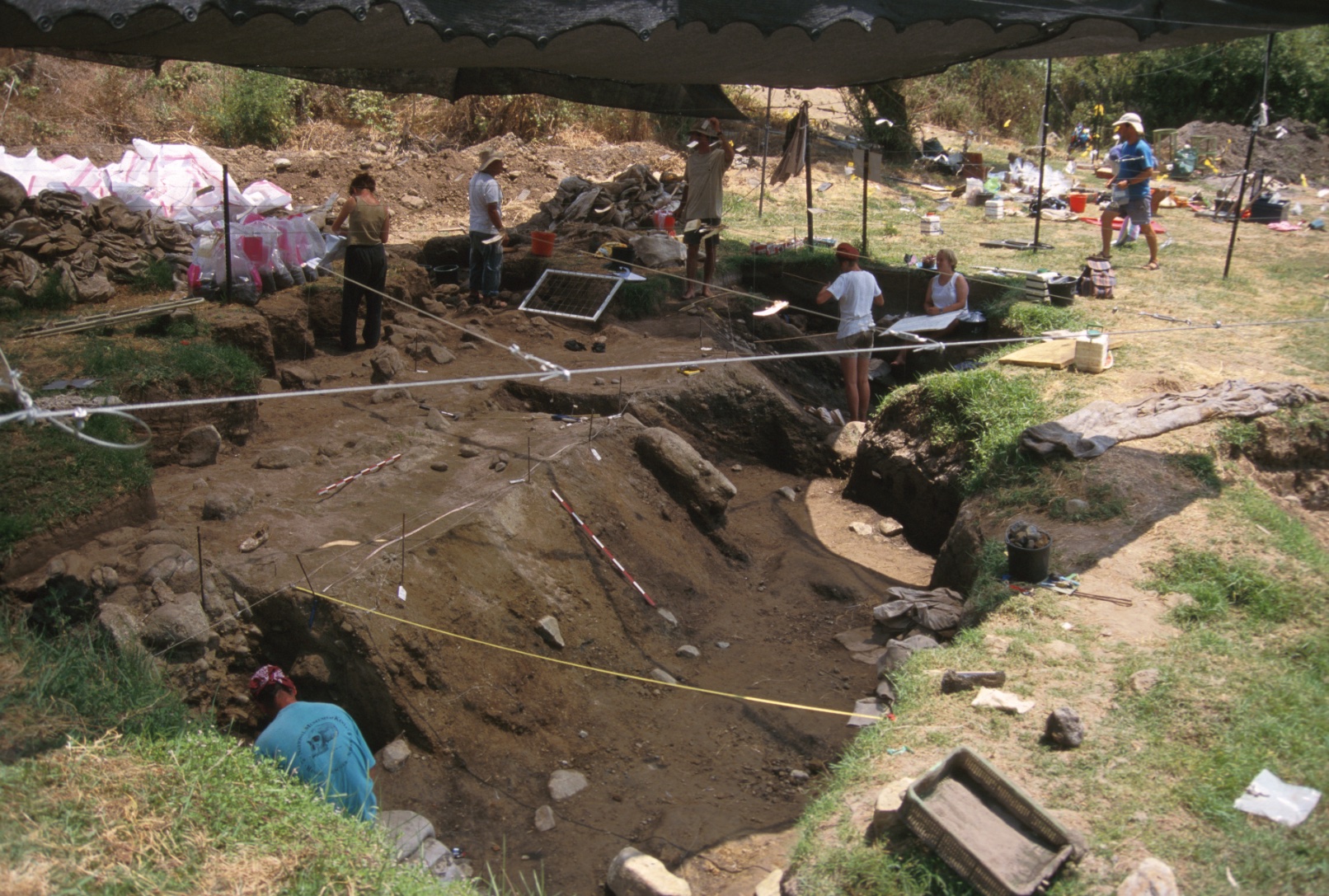
CUPRA MARITTIMA, ITALY—CNN reports that excavators working at the site of a Roman temple located near eastern Italy’s Adriatic coastline have recovered about 100 rare fragments of 2,000-year-old frescoes. Pieces of sky-blue plaster are thought to have covered the temple’s ceiling, while the walls are thought to have been decorated with red, black, and yellow squares separated by images of garlands and candelabra separated by horizontal bands of green. The rare pieces are thought to have survived because the Roman emperor Hadrian (r. A.D. 117–138) overhauled the structure in A.D. 127, including having the painted surfaces chiseled off the walls and then covered in marble to strengthen them. The plaster was then used as a base for new floors, explained Marco Giglio of the University of Naples L’Orientale. Hadrian also added columns with capitals, lion-headed roof dripstones, and two brick arches to the temple. But the marble was reused in other buildings in the seventh century, and in the nineteenth century, the surviving structure was incorporated into a house that still stands at the site. “We’re still trying to figure out whether it is best to restore it or take it down to recover the shrine in its entirety,” Giglio said. To read about a luxurious dining room unearthed at Hadrian's villa outside Rome, go to "Around the World: Italy."
Skull Study May Offer Insights Into Hominin Interbreeding
RALEIGH, NORTH CAROLINA—According to a statement released by North Carolina State University, Steven Churchill of Duke University and Ann Ross of North Carolina State University and their colleagues collected measurements of the skulls of 13 Neanderthals, 233 prehistoric Homo sapiens, and 83 modern humans to see if they could detect any evidence of interbreeding in the facial structures. “Neanderthals had big faces,” Churchill explained. Neanderthals and modern humans are thought to have mixed in the Near East—a region ranging from North Africa to Iraq—as modern humans migrated out of Africa but before they spread to Asia, he added. After the researchers accounted for environmental variables, they found that the size and shape of some facial features allowed them to track the possible mixing of the Neanderthal and modern human populations. The data also suggests that several generations after mixing with Neanderthals, modern human faces became smaller again. “But the actual shape of some facial features retained evidence of interbreeding with Neanderthals,” Churchill said. The team members would like to analyze skull measurements from additional populations, including the Natufians, who lived more than 11,000 years ago in what is now Israel, Jordan, and Syria, Churchill concluded. Read the original scholarly article about this research in Biology. To read about genetic markers that some people living today inherited from Neanderthals, go to "Neanderthal Genome," one of ARCHAEOLOGY's Top 10 Discoveries of the Decade.
Advertisement