Subscribe to Archaeology
Archaeological Headlines By JESSICA E. SARACENI
Tuesday, August 23

Earthen Mound in Louisiana Dated to 11,000 Years Ago

BATON ROUGE, LOUISIANA—According to a statement released by Louisiana State University, professor emeritus Brooks Ellwood and his colleagues have radiocarbon dated microscopic bits of charred mammal bone known as osteons and the ashes of burned reeds and cane plants found in the layers of sediment cores taken from the two 20-foot-tall earthen mounds on the Louisiana State University campus. The researchers suggest that the plants may have been burned to create very hot ceremonial fires, perhaps to cremate animals. The study also indicates that construction of the southern mound, known as “Mound B,” began some 11,000 years ago. A large depression in the ground on campus may have been a source of building material. The study suggests that the structure was then abandoned around 8,200 years ago, around the time that temperatures in the northern hemisphere dropped about 35 degrees Fahrenheit, Ellwood said. Tree roots in this layer suggest that the site had not been used for about 1,000 years when construction of “Mound A” began with mud taken from a nearby estuary. Both mounds reached their current heights about 6,000 years ago, Ellwood explained. Astronomer and team member Geoffrey Clayton suggests that the crests of the finished mounds align with Arcturus, one of the brightest stars of the night sky. To read about massive earthworks constructed some 3,200 years ago at Louisiana's Poverty Point, go to "Archaic Engineers Worked on a Deadline."

Possible Medieval Pub Found in Northern England

HUMBERSIDE, ENGLAND—BBC News reports that remains of what may be a medieval ale house have been unearthed in East Yorkshire. Archaeologist Emma Samuel said that a large number of pottery beakers and jugs have been uncovered at the site, along with carefully butchered sheep and cattle bones. “From their design, we know the beakers date back to about the thirteenth century,” she said. “The site could well have been a pub or some kind of large house, perhaps even a hostelry.” Foot travelers would have needed a safe place to stay when making long journeys, she explained. Traces of smaller buildings, a knife, chisels, and jewelry dating back to the seventh century were also recovered. To read about another archaeological discovery in England, go to "Cave Fit for a King...or a Hermit."

Burials Discovered in Peru’s Vichama Archaeological Complex

LIMA, PERU—According to an Andina report, excavations under the direction of archaeologist Ruth Shady at the Vichama Archaeological Complex, which is located near the Pacific coastline of central Peru’s Huaura province, have uncovered burials and a possible dwelling. Team member Alexander Zuñiga said that some of the objects have been dated to as early as 3,800 years ago. Two toads, tools for working cotton, and objects made with mollusk shells were found among the burial bundles, he added. Older buildings at Vichama were decorated with images of humans, snakes, and fish, while later buildings were decorated with toad figures, he explained. To read about evidence for an unusual burial treatment in Peru's Chincha Valley, go to "Dignity of the Dead."

Monday, August 22

Study Investigates Rate of Parasite Infections in a Medieval City

CAMBRIDGE, ENGLAND—According to a statement released by the University of Cambridge, friars living in Cambridge during the medieval period were almost twice as likely to be infected with intestinal parasites than the city’s general population. Research team member Tianyi Wang used a microscope to look for surviving parasite eggs in soil samples taken from the areas around the pelvises of people who had been buried in a local parish church cemetery, and from the cemetery at the site of the city’s medieval Augustinian friary. (The remains of monks were identified by the metal belt buckles associated with their order.) The study determined that 58 percent of the monks were infected with worms, compared to 32 percent of the townspeople. Roundworm was the most common parasite detected, but whipworm infection was found as well. Both of these parasites are spread through poor sanitation, Wang explained. Yet most people living at the time were likely to use cesspit toilets, while most Augustinian monasteries were equipped with water-rinsed latrines and handwashing facilities. Team leader Piers Mitchell concluded that the monks may have facilitated infection through using their own feces to fertilize their vegetable gardens, or by purchasing fertilizer that contained human or pig excrement. Read the original scholarly article about this research in the International Journal of Paleopathology. For more on Cambridge's Augustinian friary, go to "Common Ground."

Periods of Drought May Be Linked to Fall of Maya Capital

ALBANY, NEW YORK—According to a statement released by the University of Albany, prolonged drought may have contributed to the collapse of Mayapan, a Maya capital city located on Mexico’s Yucatán Peninsula that was inhabited by some 20,000 people from the thirteenth through the mid-fifteenth centuries. The city was abandoned after a rival political faction killed the ruling family. Marilyn Masson of the Proyecto Económico de Mayapan and an international team of researchers led by Douglas Kent of the University of California, Santa Barbara, found evidence of a massacre in mass graves, including bodies that had been buried with knives still in the wounds and remains that had been chopped up and burned. But dating of the bones with accelerator mass spectrometry revealed that these people had been slaughtered some 50 to 100 years before the city fell, as recorded in historical documents. Analysis of calcite deposits in nearby caves detected a period of drought that corresponds to a decline in population at Mayapan between 1350 and 1430. The rivals may have timed their attacks to take advantage of possible social unrest and food insecurity, Masson explained. Read the original scholarly article about this research in Nature Communications. To read about the rise and fall of the ancient city of Kaminaljuyú, go to "Letter from Guatemala: Maya Metropolis."

Early Medieval Graves Unearthed in Germany

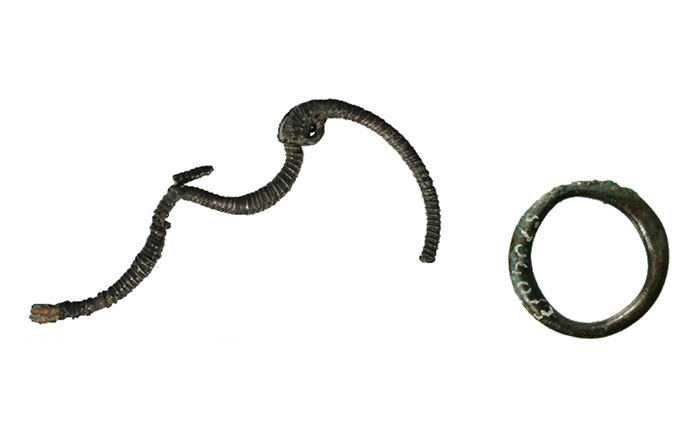
TUTTLINGEN, GERMANY—Live Science reports that more than 100 graves dated to the early medieval period, and one grave dated to the Neolithic period, were discovered near the Danube River in southwestern Germany during an investigation undertaken before the construction of a rainwater retention pond. The Neolithic grave, dated to the third millennium B.C., contained pottery attributed to the Corded Ware culture, which is named for its distinctive geometric decorations made by pressing cord into damp clay. People of the Corded Ware culture are thought to have kept cows and sheep and may have sown crops such as barley. The early medieval graves have been dated to between A.D. 500 and 600, after the fall of the Roman Empire in A.D. 476. These graves contained swords, lances, shields, bone combs, drinking vessels, and earrings. The finds push back the date of settlement of the region, otherwise dated to A.D. 1273 through written records. To read about a 4,000-year-old ringed sanctuary in central Germany, go to "Letter from Woodhenge: Stonehenge's Continental Cousin."

Friday, August 19

Remains of Victims of Stalin’s Great Purge Identified

SZCZECIN, POLAND—Science in Poland reports that geneticists analyzing samples taken from 27 sets of human remains recovered from a mass grave near a monastery in Batumi, Georgia, have identified three victims of Stalin’s Great Purge of 1937. Well-preserved DNA samples from the remains were compared to DNA samples collected from surviving family members. “Collecting genetic material from the possible families of victims was a huge challenge for our colleagues in Georgia,” explained team member Andrzej Ossowski of Pomeranian Medical University. “We would often deal with multi-generation families and it was necessary to consult on from whom to sample the material.” The team members will continue to attempt to identify the remains, he added. At least 750,000 people were executed during Stalin’s campaign to solidify his power in the Soviet Union. To read about DNA analysis of remains from a mass grave in southern Poland dating to some 5,000 years ago, go to "We Are Family."

Megalithic Standing Stones Discovered in Spain

HUELVA, SPAIN—The Guardian reports that a megalithic complex of more than 500 standing stones was discovered during a survey at La Torre-La Janera, which is located near the Guadiana River in southern Spain. The monuments include 26 alignments of standing stones, and two stone circles built on hilltops with views of the sunrise during the summer and winter solstices and the spring and autumn equinoxes. “This is the biggest and most diverse collection of standing stones grouped together in the Iberian Peninsula,” said José Antonio Linares of the University of Huelva. Linares and his colleagues estimate that the stones were erected in the second half of the sixth or fifth millennium B.C. Dolmens, mounds, and stone-lined cists were also revealed by the survey. Excavation of the stones is expected to continue into 2026. To read about a woman buried in a megalithic tomb some 5,300 years ago who received the earliest known ear surgery, go to "Around the World: Spain."

Advertisement