Subscribe to Archaeology
Archaeological Headlines By JESSICA E. SARACENI
Tuesday, August 2

New Thoughts on Maya Religion and the Ball Game

CHIAPAS, MEXICO—According to a statement released by Mexico’s National Institute of Anthropology and History, the human ashes, charcoal, rubber, and roots discovered in more than 400 vessels in a crypt at the Temple of the Sun at Toniná may have been used to make rubber balls to play the Maya ball game. Research team leader Juan Yadeun Angulo said that the sulfur in human remains would have been necessary to complete the vulcanization of the rubber. The crypt, dated from the seventh to eighth centuries A.D., is one of a network of small vaults and rooms connected by stairways deep inside the pyramid, he added. This labyrinth may have been built to represent a “cave of death” and used by priests to transform rulers’ remains over a 260-day cycle of the ritual calendar. The bodies of the rulers Wak Chan Káhk’, Aj Kololte’, and Lady Káwiil Kaan, whose names are engraved on rings in the city’s ball court, may have been treated in this way, Yadeun Angulo suggested. The team also investigated a second crypt dated to about A.D. 500, but determined that it had been looted sometime between the nineteenth and twentieth centuries. To read about a 3,400-year-old ball court discovered in southern Mexico, go to "Play Ball!"

Ancient Cowrie Shell Artifacts Identified as Octopus Lures

MANGILAO, GUAM—According to a statement released by the University of Guam, Chamorro people living throughout the Mariana Islands some 3,500 years ago made lures for hunting octopuses out of cowrie shells. Michael T. Carson of the University of Guam said that the artifacts date to the earliest occupation of the Mariana Islands, and suggests that they may be some of the oldest octopus lures ever found in the remote Pacific. The shells, which are grown by a type of sea snail that is a favorite food of octopuses, had been drilled with two holes, perhaps to connect them with a fiber cord to a stone sinker and a hook, Carson explained. However, it is not clear if the Chamorro people brought this technology with them to the Mariana Islands, or if they developed it after their arrival as they adapted to a new environment, he added. It had been previously thought that artifacts of this type may have been used for scraping and preparing breadfruit or other plant foods, such as taro. Read the original scholarly article about this research in World Archaeology. To read about one of the oldest known sites in Oceania, go to "World Roundup: Guam."

Monday, August 1

Roman Coin Recovered Off Coast of Israel

HAIFA, ISRAEL—According to a statement released by the Friends of the Israel Antiquities Authority, a bronze coin minted in Alexandria, Egypt, was discovered during an underwater survey in the Mediterranean Sea off Israel’s Carmel coast. The coin—one of a series that depicts the signs of the zodiac—dates to the eighth year of the reign of the Roman emperor Antoninus Pius, or around A.D. 144. This coin shows the zodiac sign Cancer beneath a portrait of the moon goddess Luna. Jacob Sharvit of the Israel Antiquities Authority Maritime Archaeology Unit said that the coin is the first of its kind to be found in the region and a rare addition to Israel’s national treasures. To read about tenth-century A.D. gold coins unearthed in Jerusalem, go to "Money Talks."

Friday, July 29

Colonial Horse Genome Sequenced

GAINESVILLE, FLORIDA—According to a statement released by the University of Florida, researchers have sequenced the mitochondrial genome of a sixteenth-century horse using DNA extracted from a tooth discovered at the Spanish colonial site of Puerto Real in what is now Haiti. The town of Puerto Real was first established 1507 and quickly became a center for piracy and smuggling. Spanish officials destroyed the settlement in 1579 and the site was lost to time. A medical missionary discovered remnants of the town by chance in the 1970s and a team of University of Florida archaeologists conducted excavations there between 1979 and 1990. Historical documents suggest that Europeans began to import horses to the Western Hemisphere beginning in the late fifteenth century, but there is little archaeological evidence for early colonial–era horses. University of Florida archaeologist Nicolas Delsol, who identified the horse molar fragment in an assemblage of faunal material discovered at Puerto Real, compared its DNA with that of modern horses from around the world. He discovered that the closest living relatives of the 500-year-old Puerto Real horse are not horses living today on the Iberian Peninsula, but rather wild horses that roam the island of Assateague off the coast of Maryland and Virginia. Feral horses have lived on the barrier islands stretching from Virginia to the Carolinas for centuries. They may have waded ashore from wrecked Spanish vessels, or may have been dropped deliberately by sailors intending to one day return. To read more about the archaeology of horses, go to "Taming the Horse." 

Remains of Mongol Summer Palace Investigated in Turkey

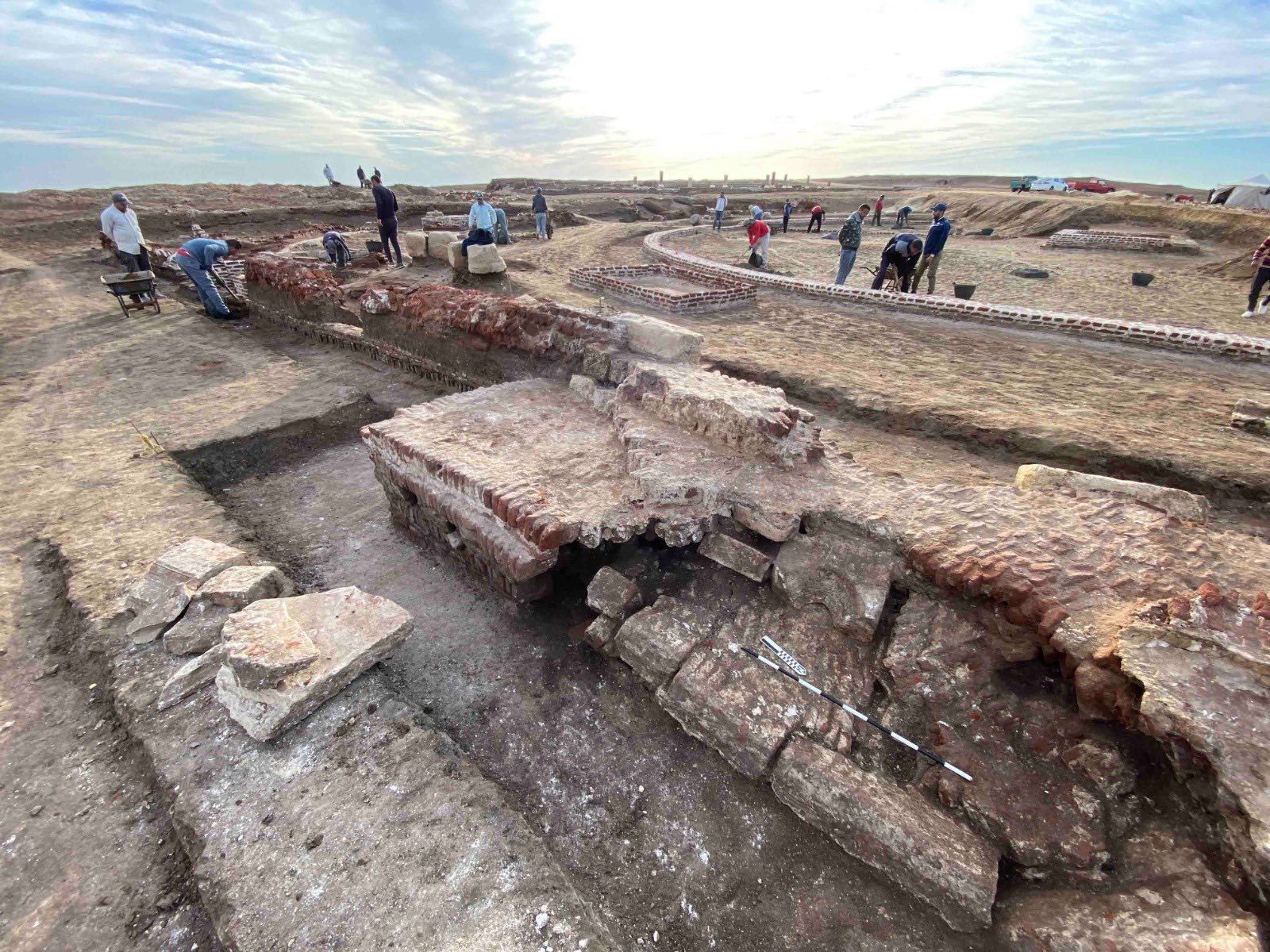
VAN, TURKEY—Artnet News reports that archaeologists in Turkey have uncovered the remains of an ancient palace that may have once belonged to Hulagu Khan, a grandson of Genghis Khan. The warlord, who lived from around A.D. 1217 to 1265, is most famous for his military exploits, including sacking Baghdad in 1258. A war between Hulagu Khan and other grandchildren of Genghis Khan over succession and plans for the Mongol Empire led to a split in 1259, after which point Hulagu Khan became the ruler of the Mongol Ilkhanid State in the Middle East. At its height, the Khanate included territory in what is now Iran, Azerbaijan, Turkey, Iraq, Syria, Armenia, Georgia, Afghanistan, Turkmenistan, Pakistan, Dagestan, and Tajikistan. Historical records indicate that sometime in the 1260s, Hulagu Khan built a summer palace in what is now the Van Province of Turkey. Archaeologists, who have yet to definitively tie any structural remains to Hulagu Khan's lost residence, have discovered ceramic fragments, bricks, roof tiles, as well as building foundations. Researchers led by archaeologist Ersel Çağlıtütuncigil of Turkey's Izmir Katip Çelebi University say that the evidence is the first of any architectural remains from the Ilkhanid State. Additionally, roof tiles bearing symols shaped like the letter S, as well as tamgas or swastika motifs—power symbols associated with Mongol Khans—have been discovered at the site. To read about the search for Genghis Khan's tomb, see "Genghis Khan, Founder of the Mongol Empire.

4,000-Year-Old Shell Tool Site Unearthed in Taiwan

TAIPEI, TAIWAN—Focus Taiwan reports that archaeologists have uncovered more than 50 burials dating to about 4,000 years ago on the southern tip of Taiwan. Some of the skeletons were interred in slate coffins with coral objects, as well as both finished and unfinished shell tools such as fishhooks. The researchers also discovered evidence of the tools and unique techniques used to craft the shell tools. Hung-lin Chiu of National Tsing Hua University said that the site is the largest and oldest known shell tool processing site in the Pacific. To read about a hominin jawbone discovered by a fisherman, go to "World Roundup: Taiwan."

Advertisement