Intact Maya Pot Unearthed in a Mexican Cave
QUINTANA ROO, MEXICO—Mexico News Daily reports that an intact Maya pot estimated to be 2,000 years old has been found in a cave in Playa del Carmen, near southern Mexico’s Caribbean coastline. Biologist and speleologist Roberto Rojo found the pot partially submerged in sediment, and alerted archaeologists José Antonio Ryes Solís and Enrique Terrones González of Mexico’s National Institute of Anthropology and History. After they carefully photographed the pot and removed the surrounding sediment, the artifact was passed along a human chain to transport it safely out of the tight space. Reyes said the pot’s exterior is reddish in color while the inside is black. An image of a plant that may be a squash adorns the surface. “It’s partially covered by calcium carbonate, which is characteristic of materials recovered in caves,” he added. To read about archaeologists' efforts to reconstruct Maya mural paintings from thousands of fragments uncovered at the site of San Bartolo in Guatemala, go to "Piecing Together Maya Creation Stories."
Medieval Shipwreck Discovered Off the Coast of England
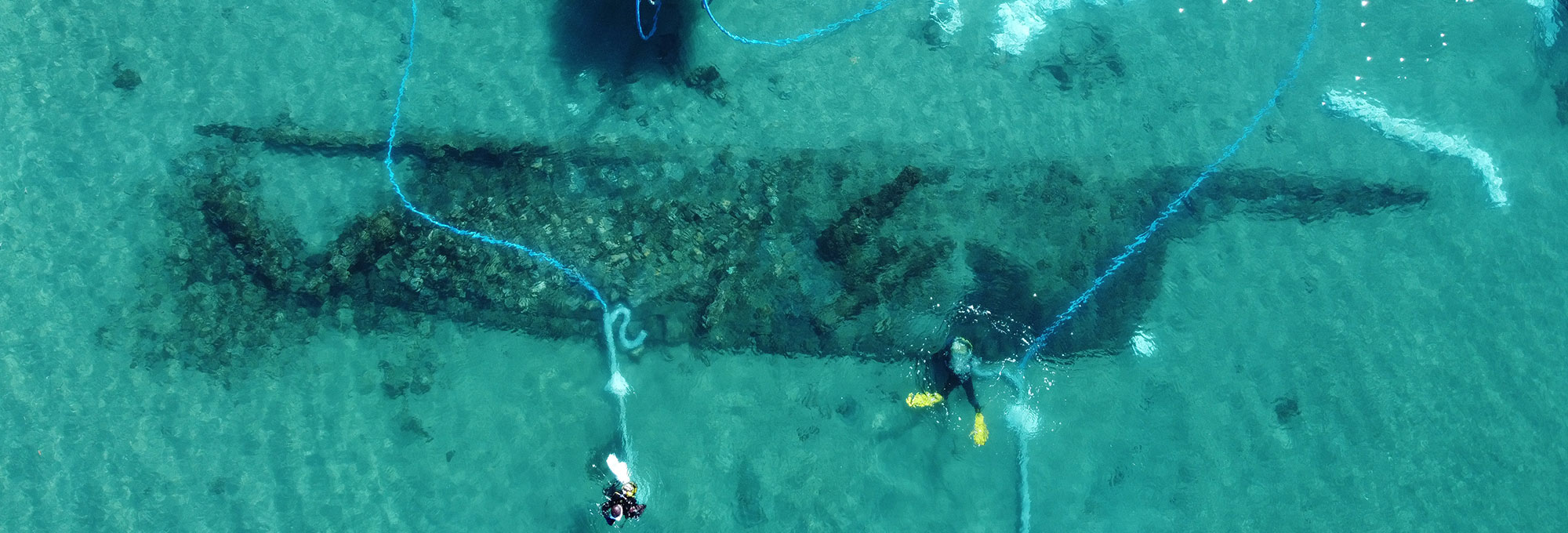
POOLE, ENGLAND—According to a statement released by Bournemouth University, a shipwreck dated to the thirteenth century through tree ring analysis of wood in the hull has been uncovered in Poole Bay, which is located off the coast of southwest England. The rare wreckage was spotted after a storm by a local charter boat skipper. Maritime archaeologist Tom Cousins explained that the combination of low-oxygenated water, sand, and stones helped to preserve one side of the clinker, a type of vessel constructed with overlapping planks of wood. This vessel, constructed with oak grown in Ireland, carried a cargo of Purbeck stone, which comes from Dorset’s Isle of Purbeck. This type of stone, which can be highly polished, was used in Gothic architecture in Britain and continental Europe. A cauldron for cooking, large Purbeck stones for grinding grain, and Purbeck gravestone slabs were also recovered. One of the gravestones was engraved with a wheel-headed cross in early thirteenth-century style, while the other had a splayed arm cross, which was popular in the mid-thirteenth century. It had not been known that the two styles were in use at the same time, said Brian and Moira Gittos of the Church Monuments Society. The gravestones are thought to have been carved at a local quarry or workshop. To read about the crew of an English warship that sank in 1545, go to "Tudor Travelers."
Study Investigates Climate and Collapse of Maya City
YUCATÁN, MEXICO—According to a statement released by the University of California, Santa Barbara, anthropologist Douglas Kennett and his colleagues suggest that a prolonged period of drought may have led to food shortages, population decline, political rivalries, civil conflict, and the abandonment of the Maya city of Mayapan sometime between A.D. 1441 and 1461. The researchers analyzed human remains from the site, which is located in southern Mexico, and compared what they found with climate data and records of drought from cave deposits beneath the city, Kennett explained. The study suggests that reliance on maize crops without a centralized system of long-term grain storage, minimal irrigation systems, and a sociopolitical system led by elites who had competing political interests contributed to the collapse of the city. Read the original scholarly article about this research in Nature Communications. To read about the only Maya city with an urban grid, go to "The City at the Beginning of the World."
Has the Ancient City of Natounia Been Found in Iraq?
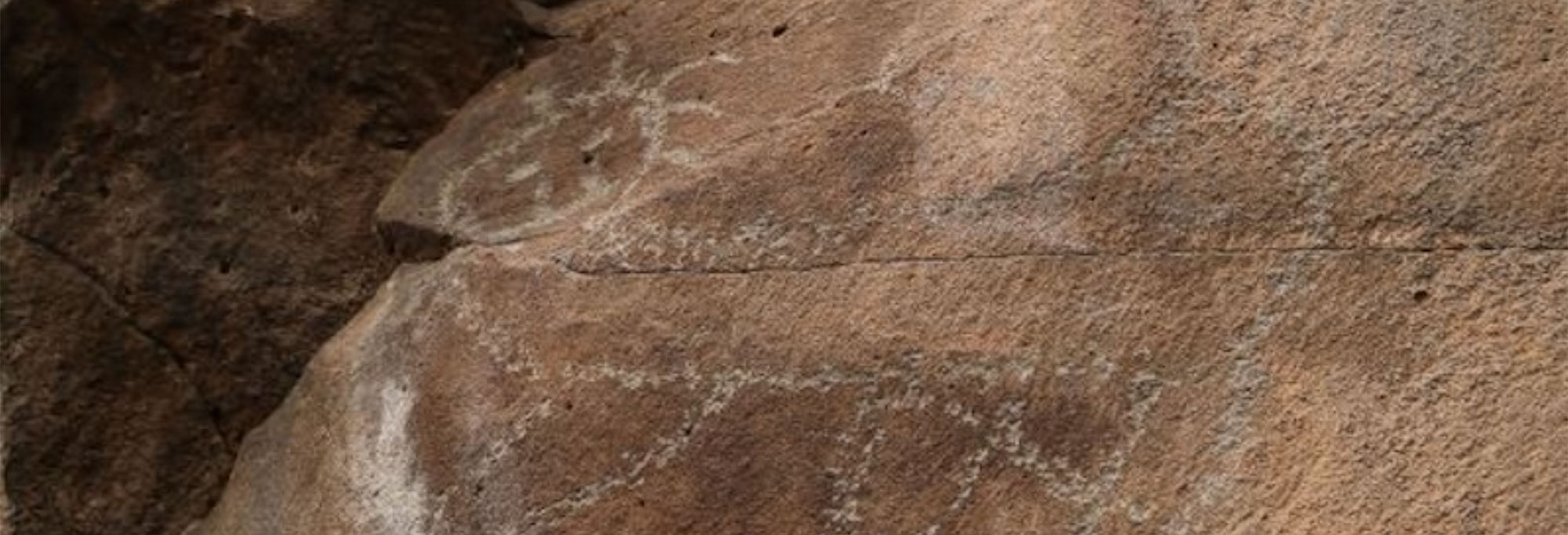
KURDISTAN, IRAQ—According to a CNN report, traces of a 2,000-year-old stone fortress, two settlements, and a religious complex found in the Zagros Mountains in northern Iraq may be the ancient city of Natounia. Michael Brown of Heidelberg University and his colleagues said the site, known as Rabana-Merquly, is located on the ancient border of Adiabene, a minor kingdom that paid tribute to the Parthian Empire. Rock carvings found at the entrance to the fortress are thought to depict a king of Adiabene, based upon the clothing and hat worn by the figure. A similar carving has been found in the ancient city of Hatra, located about 140 miles away. “Natounia is only really known from its rare coins, there are not any detailed historical references,” Brown explained. Information from the seven known coins provide the name of the king Natounissar, and a location on what is now known as the Lower Zab River. Brown noted that some high-status tombs were also found near the fortress. “It’s a circumstantial argument,” he explained. “Rabana-Merquly is not the only possibility for Natounia, but arguably the best candidate by far [for] the ‘lost’ city, which has to be in the region somewhere,” he concluded. To read in depth about a Bronze Age Iranian settlement known as “Burnt City,” go to “The World In Between.”
Graves at Williamsburg’s First Baptist Church Will Be Excavated
WILLIAMSBURG, VIRGINIA—The Daily Press reports that the descendant community from the current First Baptist Church congregation voted unanimously to excavate three of the 41 grave shafts identified at the original First Baptist Church site, which is located on South Nassau Street at the edge of Colonial Williamsburg. The congregation was started by free and enslaved African Americans in 1776, and met at the site from 1818 to 1956, when Colonial Williamsburg was founded and the congregation moved to another location. One of the graves to be exhumed was marked with an upside-down wine bottle—the only grave marker found so far. Archaeologists will look for human remains, try to determine when they were buried, and if conditions allow, remove the bones for study at William & Mary to determine age at death, stature, injuries, illnesses, stresses, and places of origin. The researchers also plan to collect samples for DNA testing. Any artifacts recovered from the graves will be cleaned and catalogued at Colonial Williamsburg, and will eventually be reinterred along with the remains on the original site. To read about a community established by enslaved African Americans seeking their freedom, go to "Letter from Virginia: Free Before Emancipation."
Scan of Fossilized Skull Reveals Hunter-Gatherer’s Hearing Loss
COIMBRA, PORTUGAL—The Portugal Resident reports that researchers from the University of Coimbra recently examined the 100,000-year-old fossilized skull of a modern human discovered in Morocco some 50 years ago with computer-assisted microtomography, and determined that the hunter-gatherer probably suffered from a chronic ear infection. As team member Dany Coutinho Nogueira and his colleagues evaluated the images of the skull, they noticed that the individual suffered from Labyrinthitis ossificans, a disease in which parts of the ear turn to bone. The ossification of this individual’s semicircular canals, which aid in maintaining balance, probably caused hearing loss, dizziness, and symptoms of vertigo that made it difficult to acquire food and hunt, Coutinho Nogueira explained. The individual would have required the care for the few months between the onset of the disease and death, he added. To read about recent reconstructions of hominin inner-ear anatomy, go to "Neanderthal Hearing."
Advertisement