New Thoughts on the Rise of Complex Societies
COVENTRY, ENGLAND—According to a statement released by the University of Warwick, Joram Mayshar of the Hebrew University of Jerusalem, Omer Moav of the University of Warwick and Reichman University, and Luigi Pascali of Pompeu Fabra University and the Barcelona School of Economics claim that the production of cereal crops alone fueled the development of hierarchical societies. Unlike root crops, which can be kept in the ground, cereal crops must be harvested and stored, making them easier to access and tax, the researchers explained. It had been previously thought the growth of early hierarchies was driven by the availability of fertile land, but the study, which examined the level of hierarchical complexity in a society, the geographic distribution of wild relatives of domesticated plants, and land suitability for various crops, suggests that the most productive lands, where roots and tubers were grown in addition to cereals, did not experience the same political development as societies that relied solely on the growth of cereal crops, Pascali explained. “When it became possible to appropriate crops, a taxing elite emerged, and this led to the state,” Mayshar concluded. To read more about the role of taxation in the rise of empires, go to "Ancient Tax Time."
Europe’s First Farmers May Have Been Shorter Than Expected
STATE COLLEGE, PENNSYLVANIA—According to a statement released by Pennsylvania State University, George H. Perry, Stephanie Marciniak, and an international team of researchers evaluated DNA samples and the long bones of people who lived in Europe between 38,000 and 2,400 years ago to look for possible negative health effects experienced by the first farmers of the Neolithic period. Marciniak explained that, while taking into account a person’s genetic ancestry as populations migrated across Europe, the switch from hunting and gathering to farming did not always result in loss of height, but in some parts of Europe, early farmers were about 1.5 inches shorter than their hunter-gatherer predecessors. Heights eventually increased, however, so that individuals who lived during the Iron Age were some 1.29 inches taller than Neolithic farmers. Marciniak said that additional data is needed to explore genetic variants associated with height and possible causes in the decrease of achieved height. Read the original scholarly article about this research in Proceedings of the National Academy of Sciences. For more, go to "Europe's First Farmers."
2,600-Year-Old Tomb Discovered in Istanbul
ISTANBUL, TURKEY—The Anadolu Agency reports that a brick tomb dating to the sixth century B.C. has been uncovered during work to renovate the Haydarpasa Train Station, which is located in Anatolia near the northern shore of the Sea of Marmara. Rahmi Asal of the Istanbul Archaeological Museum said the tomb is one of the oldest discoveries in the area. Preliminary analysis suggests the body had been burned within the tomb, but the skeleton and artifacts, including a terracotta goblet and a perfume bottle, survived with just some fire damage. “I have never seen this type of a cremation tomb from the Hellenistic period,” Asal said. “Perhaps this will give us many more valuable insights.” To read about recently uncovered victims of the eruption of Thera some 3,600 years ago, go to "Around the World: Turkey."
Traces of 4,000-Year-Old Boat Excavated in Iraq
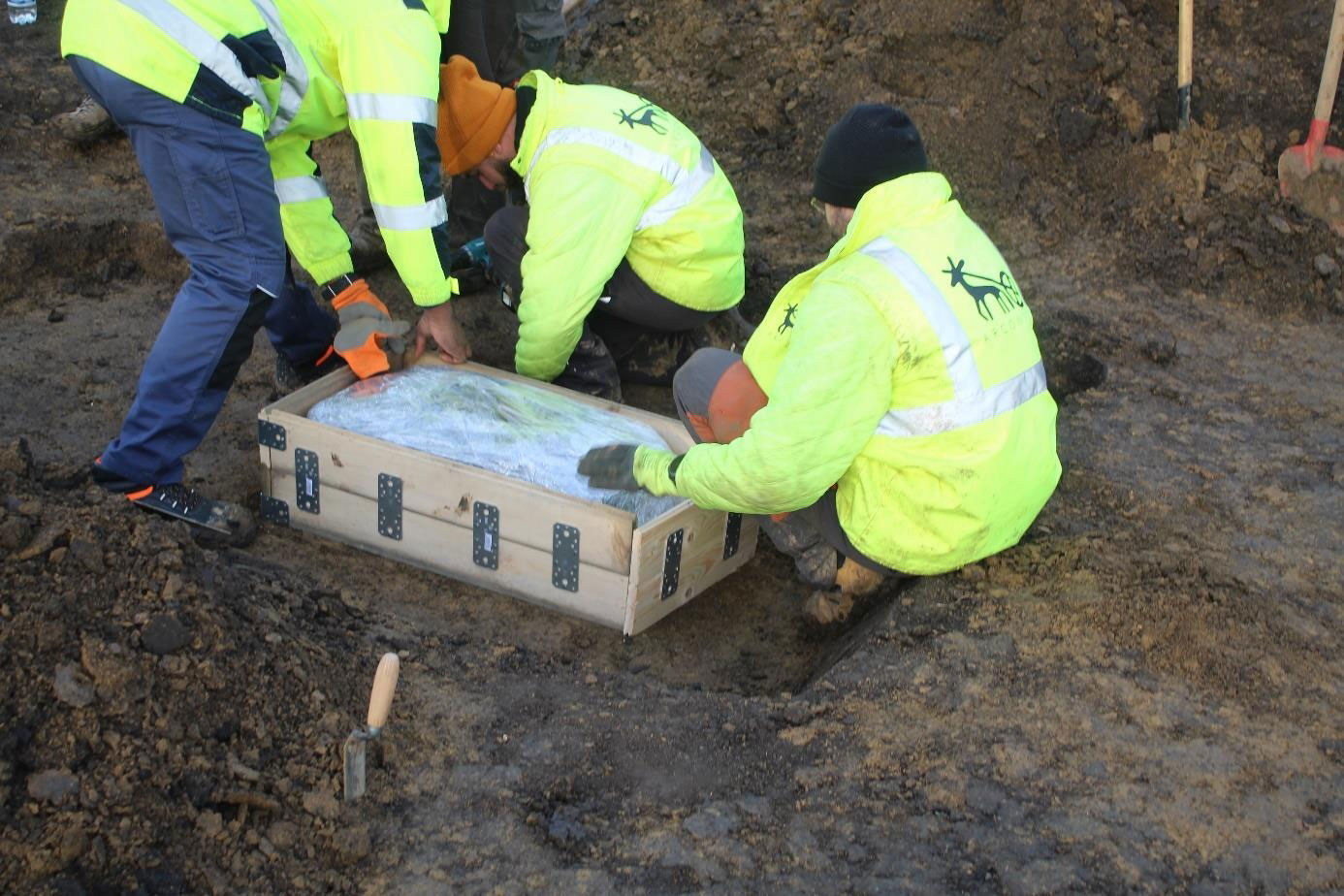
BAGHDAD, IRAQ—According to an Ars Technica report, a team of researchers from the Iraqi State Board of Antiquities and the German Archaeological Institute has removed a block of sediment containing traces of a 4,000-year-old boat from a site that was once a river flowing on the outskirts of the ancient city of Uruk, in what is now southern Iraq. When erosion of the riverbed first revealed the outline of the boat in 2018, archaeologists documented the vessel, which measures about 22 feet long and five feet wide. The recent increasing rate of erosion at the site and nearby traffic prompted the researchers to remove the delicate imprints of bitumen that once covered the reeds, palm leaves, or wood of the craft. Archaeologists at the Iraq Museum will study and conserve what is left of the hull for eventual display. To read about the Mesopotamian ruler whose reign marked the end of the Neo-Babylonian Empire, go to "The Last King of Babylon."
New Thoughts on the Peopling of Eurasia
BOLOGNA, ITALY—According to a statement released by the University of Bologna, Leonardo Vallini, Luca Pagani, and Telmo Pievani of the University of Padova and Giulia Marciani and Stefano Benazzi of the University of Bologna compiled genetic and archaeological data to produce a picture of the movements of modern humans in East Asia and Europe. The researchers suggest that there were several waves of expansion and local extinction from a theoretical population hub where the ancestors of all Eurasians lived after migrating out of Africa some 60,000 to 70,000 years ago. In this scenario, the location of the population hub is unknown. The researchers suggest that more than 45,000 years ago, a group of modern humans, represented by remains discovered in the Czech Republic at the site of Zlatý kůň, eventually died out. This group is not related to modern Europeans or Asians. Then, about 45,000 years ago, a new migration out of the hub spread from Europe to East Asia and Oceania. This group produced stone tools associated with the Initial Upper Paleolithic, Vallini explained. Members of this group thrived and became the ancestors of modern East Asians, but eventually died out in Europe, as represented by remains found in Bulgaria at the site of Bacho Kiro and the Oase individual in Romania. Finally, some 38,000 years ago, another wave of people left the hub and spread across Europe, where some of them interacted with descendants of the earlier wave, Pagani said. However, the two groups of people mixed much more frequently in Siberia, where they became the Ancestral North Eurasian population, he added. In Europe, this last migration is associated with the artifacts of the Upper Paleolithic in this scenario, concluded Pievani. To read about the origins of modern Japanese people, go to "Japan's Genetic History."
Evidence of Ancient Tsunami Uncovered in Chile
SANTIAGO, CHILE—Ars Technica reports that evidence of a massive earthquake and tsunami that occurred some 3,800 years ago has been uncovered at archaeological sites along the coast of Chile’s Atacama Desert by Diego Salazar and Gabriel Easton of the University of Chile and their colleagues. At a site known as Zapatero, the researchers uncovered a house made of stones situated on top of a massive shell midden. The stone walls had fallen inward, as if they had been hit by a wave. The stones of another dwelling were scattered back toward the sea, as if they had been pulled along by tsunami backwash, Salazar said. In a third house, the team members found floors covered in a layer of sand full of marine algae, echinoderm spines, chunks of rocks, shells, and sediments from disturbed layers of ground. Deep channels at the site are also thought to have been gouged by the tsunami’s current, he added. Surveys along the coastline uncovered similar signs of disaster at other archaeological sites, Salazar explained. After the disaster, the presence of small hearths suggests that most people only returned to the coast for short visits, perhaps to fish. A nearby iron oxide mine, however, was abandoned. Read the original scholarly article about this research in Science Advances. For more about the Atacama Desert, go to "Off the Grid: San Pedro de Atacama, Chile."
New Dates Push Back Occupation of Northwestern Australia
PILBARA, AUSTRALIA—The Guardian reports that stone tools, charcoal, and bone unearthed in northern Western Australia at Yirra, a site sacred to Yinhawangka Traditional Owners, have been dated to at least 50,000 years ago. Yirra is situated very close to a land bridge travelled by trucks carrying ore away from a nearby mine pit, causing erosion and boulders to roll into the site. “Important sites like Yirra need to be protected, especially when they turn out to be amongst the oldest known places of human habitation in Australia,” commented Halloway Smirke, chair of the Yinhawangka Aboriginal Corporation. “We would still be visiting this site if it wasn’t for the mining leases.” The mining company has acknowledged the significance of the site and pledges to protect it in the future. To read about newly discovered rock art panels painted by ancient Aboriginal ancestors 10,000 years ago, go to "Letter from Australia: Where the World Was Born."
Researchers Reconstruct Likenesses From 400-Year-Old Bones
WROCŁAW, POLAND—Science in Poland reports that the bust of an elderly man and digital images of a young man and woman have been recreated from remains unearthed near the border between Germany and Poland some 100 years ago. It had been previously thought that the remains dated to the early medieval period, since they were found in an early medieval stronghold, but recent radiocarbon dating conducted by Barbara Kwiatkowska of Wrocław University and her colleagues revealed that the remains dated from the end of the fifteenth century to the beginning of the seventeenth century, long after the stronghold had been abandoned. “This is another example that it is worth it to re-analyze past archaeological discoveries with modern research tools,” commented team member Paweł Konczewski of Wrocław University. To read about a cemetery belonging to the Lusatian culture, go to "World Roundup: Poland."
Does Composition of Roman Coins Reflect Currency Crisis?
COVENTRY, ENGLAND—According to a statement released by the University of Warwick, Kevin Butcher of the University of Warwick, Matthew Ponting of the University of Liverpool, and Adrian Hillier of the ISIS Neutron and Muon Facility at the STFC Rutherford Appleton Laboratory analyzed the composition of Roman denarii minted between about 200 B.C. and A.D. 64 in an effort to understand the Roman economy. In his essay De Officiis, Roman statesman Marcus Tullius Cicero wrote around 86 B.C. of a financial crisis in which “the coinage was being tossed around, so that no one was able to know what he had.” The researchers found that denarii minted before 90 B.C. had been made of pure silver, but within five years, the silver had been cut with up to 10 percent copper. Some of the coins in the study were just 86 percent silver, Ponting said, indicating a severe currency crisis after years of war. Butcher suggests this addition of copper to the mix could be behind Cicero’s claim that the coinage was “tossed around.” Cicero also wrote that the Roman tribunes and college of praetors restored the denarius to a high-quality currency under an edict issued by Marius Gratidianus, who took credit for the very popular currency reform. To read about taxation under the Roman Empire, go to "Ancient Tax Time: Filling the Coffers."
Advertisement