

Rare Turtle Statue Found in Angkor
SIEM REAP, CAMBODIA—A rare sandstone sculpture of a turtle has been found at Bayon Temple in the Angkor Archaeological Park in Siem Reap, according to a report in The Phnom Penh Post. The Bayon temple was built in the late twelfth and early thirteenth century A.D. during the reign of the Khmer ruler Jayavarman VII (reigned 1181–1220) and is best known for the many enormous carved faces of the Buddha that adorn its highly decorated exterior. The sculpture was found beneath a previously unknown pond by archaeologists from the Apsara National Authority (ANA), which oversees the park. “While many believed there was nothing left to find, our archaeological research has uncovered evidence that Bayon Temple actually boasted two ponds on its eastern side,” says ANA spokesperson Long Kosal. “This necessitates a reassessment of the historical significance of these sites.” Bayon Temple is just one of hundreds of structures built by the Khmer rulers from the ninth to fifteenth century, including Angkor Wat and Angkor Thom, that are now inside the 155-square-mile park. To read about a lidar survey of 900 square miles of the greater Angkor region, go to "Angkor Urban Sprawl," one of ARCHAEOLOGY's Top 10 Discoveries of 2017.
Teotihuacan's Pyramids Damaged By Ancient Earthquakes
MADRID, SPAIN—A new study of pyramids at the ancient city of Teotihuacan by a team of Spanish geologists has documented damage to the structures caused by five devastating megathrust earthquakes that hit the site between about A.D. 100 and 600, Live Science reports. At its height, the population of Teotihuacan, which is located northeast of Mexico City, reached some 100,000 residents. Megathrust earthquakes occur at subduction zones of tectonic plates, and though they tend to happen more infrequently than other seismic events, their magnitude is much greater. The researchers recorded the effects of immense ground shaking on the Temple of the Feathered Serpent, the Pyramid of the Sun, and the Pyramid of the Moon. The structural damage included fracturing and dislodging of large masonry blocks used to construct the buildings, as well as chipping of blocks that comprised the pyramids' outer stairs. "The initial response by the Teotihuacanos was to reinforce the Sun Pyramid, the largest structure in their city, along its north-south axis in an attempt to fortify it against future earthquakes," said geologist Raúl Pérez-López of the Geological and Mining Institute of Spain. "Additionally, they repurposed and removed other elements damaged by seismic activity. Interestingly, they opted to conceal one of the most conspicuous signs of earthquake damage: the rotation and displacement of the west staircase of the Temple of the Feathered Serpent." Despite these efforts, he said, the earthquakes were likely a contributing factor to the city's precipitous population decline and later abandonment at the end of the seventh century. "The disruption caused by a devastating earthquake not only shakes the physical foundations of a society but also destabilizes its social and political structures," Pérez-López concluded. "This creates fertile ground for unrest, potentially sparking rebellions fueled by neighboring cities and exacerbating existing tensions." Read the original scholarly article about this research in Journal of Archaeological Science: Reports. To read about liquid mercury found beneath the Feathered Serpent Pyramid, go to "Mythological Mercury Pool," one of ARCHAEOLOGY's Top 10 Discoveries of 2015.
Sacred Spring Unearthed Beneath Roman Ruins in France
PARIS, FRANCE—According to a Live Science report, near the village of Chamborêt north of the French city of Limoges, archaeologists have uncovered a freshwater spring likely dating to between 4,500 and 6,000 years ago below the remnants of a Roman-era pool. The Roman ruins, which date to the third century A.D., probably formed a landscaped basin surrounded by a wall of granite stones. A team of archaeologists from the French National Institute of Preventive Archaeological Research (INRAP) have also recovered Late Roman pottery sherds, coins, and a ceramic fragment that potentially depicts the face of Medusa or a water deity. Prior to Roman occupation, the earliest evidence of structures at the site includes a rectangular dry-stone building, postholes, sandpits, and what may have been a wood building. Such structures, they believe, were likely part of a home and farm that had been abandoned for several centuries before its revival during the Roman era. An ancient pit found beneath the pool alongside several objects date to the site’s earliest occupation during the Neolithic period. Artifacts from that era include fragments of flint, bricks and tiles singed from a fire, and pieces of a Grand Pressigny dagger—named for another Neolithic site in France. The discoveries, according to the team, offer a glimpse into regional life during Late Antiquity and the transition to the early Middle Ages. For more on the archaeology of Roman Gaul, go to “Off the Grid: Vienne, France.”
Advertisement
“Porcelain Gallbladder” Identified in Mississippi
JACKSON, MISSISSIPPI—According to an Atlas Obscura report, a “porcelain gallbladder” has been identified among a woman's 100-year-old bones exhumed from the cemetery at the site of the Mississippi State Lunatic Asylum, which operated from 1855 to 1935. A porcelain gallbladder forms through calcium build-up in the wall of the organ, which causes it to harden. Upon initial examination during the course of excavations, researchers did not know what the object, which was approximately the size of a quail egg, was. “Someone thought it was a calcified cyst, someone else thought it was a gallstone, and I thought, ‘that’s way too big to be a gallstone,’” said bioarchaeologist Jennifer Mack of the University of Mississippi Medical Center (UMMC). A retired surgeon who was a member of the team was able to identify the object. Mack added, “He came over, and as I was opening the bag, he said ‘I think that’s a calcified gallbladder.’ Because as a surgeon, he had seen them on multiple occasions before." A micro-CT scan conducted at the UMMC showed that the woman’s gallbladder also contained a large gallstone. Gallstones were detected in another five people buried in the asylum cemetery, where as many as 7,000 people may have been buried. For more on archaeology in Mississippi, go to "Letter from the American Southeast: Spartans of the Lower Mississippi."
18th-Century Foundation Uncovered at Colonial Williamsburg
WILLIAMSBURG, VIRGINIA—The foundation of an eighteenth-century house was uncovered during an excavation at Colonial Williamsburg, according to a WAVY report. The Colin G. and Nancy N. Campbell Archaeology Center is scheduled to be built on the site. Archaeologist Jack Gary of the Colonial Williamsburg Foundation said that the house had plaster walls, casement windows, a chimney on at least one side, and a cellar. The thousands of artifacts recovered during the excavation will be conserved, housed, and exhibited in the new facility. The new building may also be constructed so that visitors can see the site while strolling the hallways, Gary explained. To read about evidence of a seventeenth-century fire that destroyed a church in Jamestown, Virginia, go to "Burn Notice."
Miniature Portrait of Alexander the Great Found in Denmark
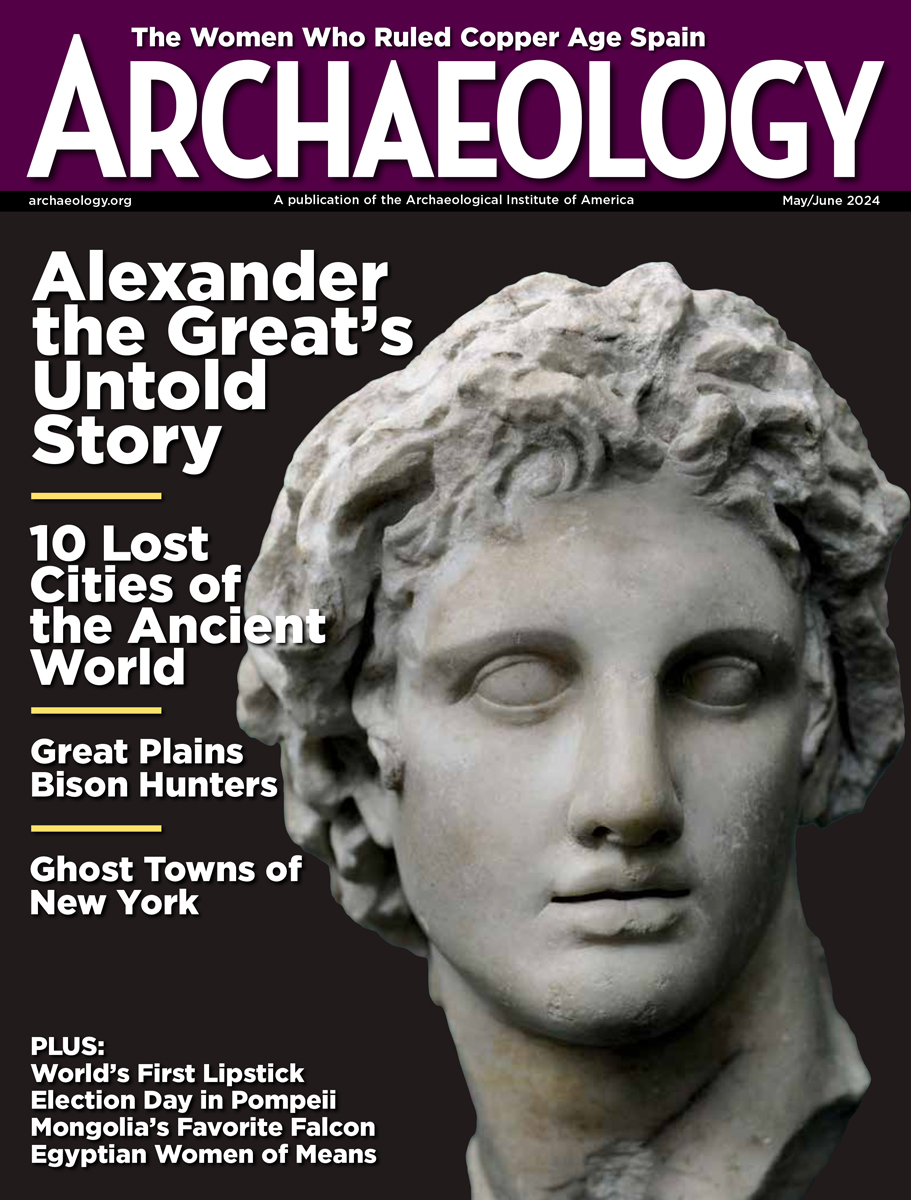
RINGSTED, DENMARK—Live Science reports that a miniature bronze alloy fitting bearing a portrait of Alexander the Great was discovered on an island in Denmark by a pair of metal detectorists who were conducting a survey. Alexander the Great succeeded his father as the king of Macedon and eventually created a far-flung empire before his death in Babylon in 323 B.C. at the age of 32. The one-inch round fitting, known as a bracket, shows an engraved image of a man with wavy hair wearing a crown made up of twisted ram horns, which are typical imagery of the ancient ruler. “The image is almost identical to another bracket portrait found years ago that contains the same stylized image,” said archaeologist Freerk Oldenberger of Museum West Zealand, where the newly unearthed bracket is being held. It has been dated to the early third century A.D., during the rule of the Roman emperor Caracalla (reigned A.D. 211–217), and its metal has a high lead content, similar to metal found in Roman bronze statuettes. “It’s possible that a statuette was melted down to make this portrait,” Oldenberger explained. “We know that [Caracalla] was completely obsessed with Alexander the Great and was interested and inspired by him, since he was the greatest conqueror of that time period,” he added. This bracket may have decorated a Roman shield or a sword belt. To read about the search for Alexander's tomb, go to "In Search of History's Greatest Rulers: Alexander the Great, King of Macedon."
Prehistoric Tools Uncovered in Northern England
CUMBRIA, ENGLAND—An excavation conducted in northern England ahead of a road improvement project along an ancient pathway has uncovered flint tools dated to the Upper Paleolithic period, according to a Newsweek report. The tools could be between 10,000 and 14,000 years old, when the climate would have been colder. Hunter-gatherers likely followed herds of reindeer, wild horses, and wild cattle over a wide range, said archaeologist Stephen Rowland. The tools were found in a pit that had been sealed by soil that washed down a nearby slope. The researchers will look for traces of an encampment that may have also been preserved through the same process. To read about monuments uncovered during construction of Cambridgeshire's A14 roadway, go to "Letter from England: Building a Road Through History."
Stolen Ramesses II Sculpture Returned to Egypt
CAIRO, EGYPT—Ahram Online reports that a fragment of a sculpture of Ramesses II stolen some 30 years ago was handed over to Egyptian authorities by Swiss officials. The 3,400-year-old carving, which shows the pharaoh’s face, was taken from the Ramesses II temple in Abydos. The sculpture originally featured Ramesses II with a group of deities. It was recovered in Geneva during a criminal proceeding. To read about recent finds at the temple of Ramesses II in Abydos, go to "Ram Heads for Ramesses."
Bear Bone Engraved by Neanderthals Studied
WROCŁAW, POLAND—IFL Science reports that a team of researchers led by Tomasz Płonka and Andrzej Wiśniewski of the University of Wrocław has examined an engraved bear bone with microscopy and X-ray computed tomography. Discovered in the 1950s in southern Poland’s Dziadowa Skała Cave, the bone has been dated to between 115,000 and 130,000 years ago, and is thought to have been engraved by Neanderthals. The researchers determined that the marks on the bone are orderly, and do not resemble marks made by butchery or accident, or as a side-effect of another activity. Experiments aimed at recreating the marks show that they were made by a right-handed person using a retouched stone tool using repeated movements, all in one direction. All of the marks are also thought to have been made at the same time, perhaps as decoration or as numerical notation. The researchers concluded that the incisions are evidence for the use of symbols. Read the original scholarly article about this research in Journal of Archaeological Science. To read about the earliest known bone point, go to "The Bone Collector."
Bottles of 18th-Century Cherries Discovered at Mount Vernon
MOUNT VERNON, VIRGINIA—According to a Washington Post report, two bottles containing liquid and some surviving cherries have been uncovered in the dirt basement of George Washington’s plantation home. The excavation was conducted as part of a project to conserve the mansion’s foundation. Archaeologist Jason Boroughs said that much of the liquid in the bottles may be groundwater that entered the vessels after their corks had deteriorated. While emptying the bottles, members of the research team found pits, stems, cherries, and gooey residues. “It actually smelled like cherry blossoms when we got to the bottom,” Boroughs said. The contents were placed in small containers for later analysis. Conservator Lily Carhart determined that the bottles were imported from England in the mid-eighteenth century, and were likely filled with cherries picked at Mount Vernon by enslaved people, then buried in the storage area between 1758 and 1776. “There are eighteenth-century accounts that talk about proper ways of preserving fruits and vegetables,” Boroughs explained. “One of the most common, especially for berries, is to dry them as much as possible… put them in a dry bottle, cork it… and then bury them,” he added. Treated in this manner, the fruit was expected to last for a year. Additional bottles may yet be recovered as the project continues. To read about artifacts uncovered at the site of a 1754 battle where troops were led by Washington, go to "Around the World: Pennsylvania."
Advertisement