|
|
Roman-Era Industrial Zone Discovered in Egypt
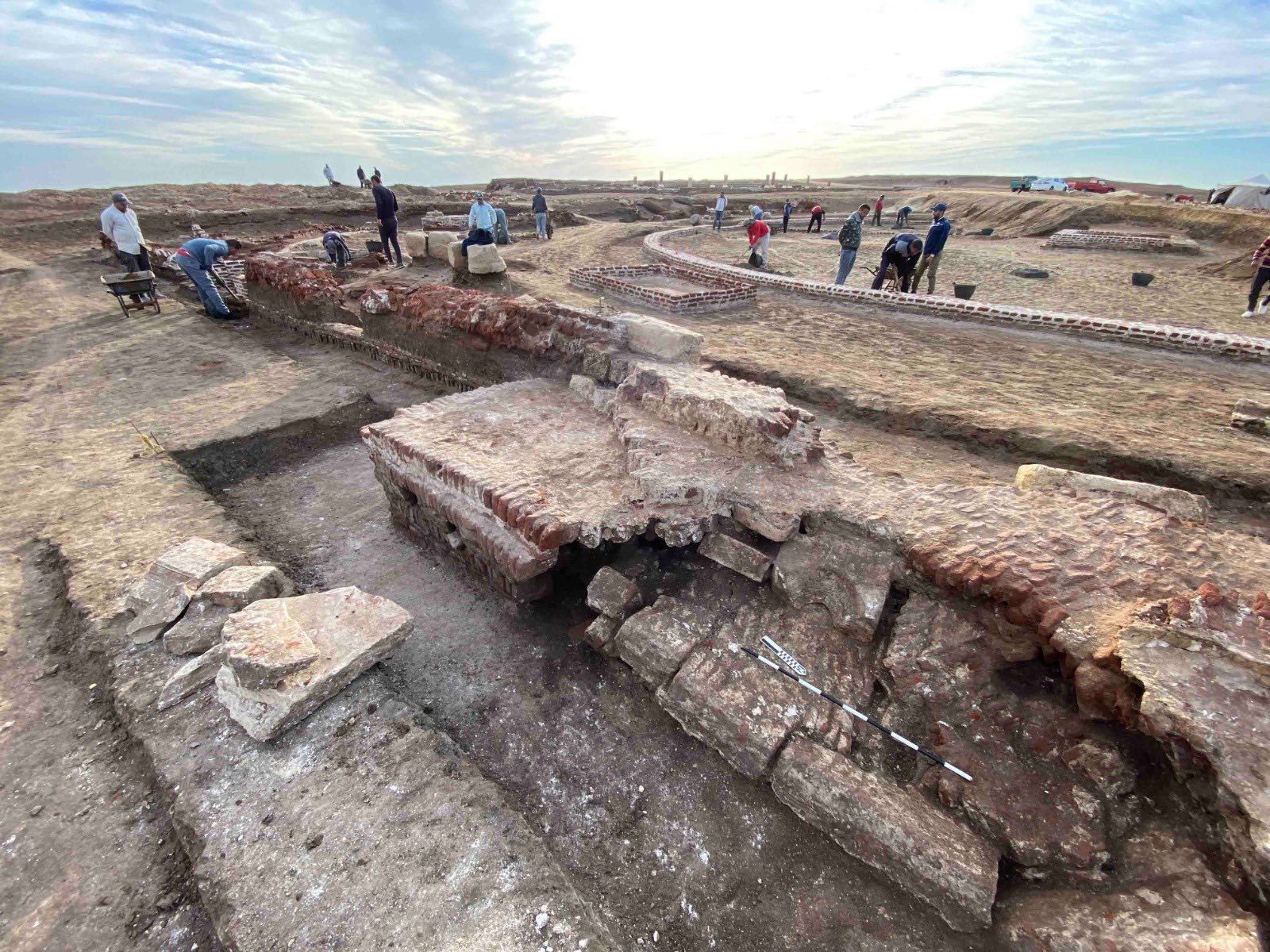
CAIRO, EGYPT—A third-century industrial zone where amphorae, tableware, and bronze statues were produced has been uncovered at the site of Tell Abu-Seifi, in the northern Sinai. Administrative buildings, galleries, and a residential area were also found. An engraving at the site shows how Roman soldiers in the region were divided and distributed among local military castles. “It is a very important discovery that highlights Egypt’s economical and commercial relation with its neighboring countries on the Mediterranean Sea,” said Mohamed Ibrahim, Minister of State for Antiquities.
A Knight’s Family Crypt Unearthed in Scotland
EDINBURGH, SCOTLAND—A month ago, while digging in a parking lot, archaeologists uncovered the grave of a man who had been buried in a medieval sandstone tomb with an ornate sword. Seven additional skeletons, including three adults and four infants, have been found, leading the team to believe the site is a knight or nobleman’s family crypt. “This site just keeps on getting more interesting—it is turning out to be a real treasure trove of archaeology. We just can’t seem to stop finding skeletons and bones,” said archaeologist Ross Murray. A new building for the University of Edinburgh will be constructed on the site.
“Wise Man” Petroglyph Found in Veracruz
MEXICO CITY, MEXICO—Farmers discovered a group of 500-year-old petroglyphs at the foot of the Cerro del Sombrete in northern Veracruz. According to Maria Eugenia Maldonado Vite of the National Institute of Anthropology and History, one of the images, inscribed on a large rock, represents a priest or wise man. “In his left hand (the only one visible) he wears a symbol that could represent a cane or a time glyph, also the rest of the scene is composed of four elements that can be interpreted as solar or astronomical connotations,” she explained.
Pyramid Builders Were Well Fed
GIZA PLATEAU, EGYPT—The 10,000 workers who built the pyramid of Menkaure are known to have lived in a town located to the south of the Sphinx. A new analysis of animal bones from the site suggests that those workers and their overseers were supplied with more than 4,000 pounds of meat from cattle, goats, and sheep a day, in addition to fish, beans, lentils, grain, beer, and other foods. “They probably got a much better diet than they got in their village,” said Richard Redding of Ancient Egypt Research Associates. The tens of thousands of animals and their caretakers would have been spread out across the Nile Delta, until they were brought to the workers’ town for consumption. Archaeologists have recently found a structure with a round pen where the animals may have been slaughtered.
Buried Couple Found Holding Hands
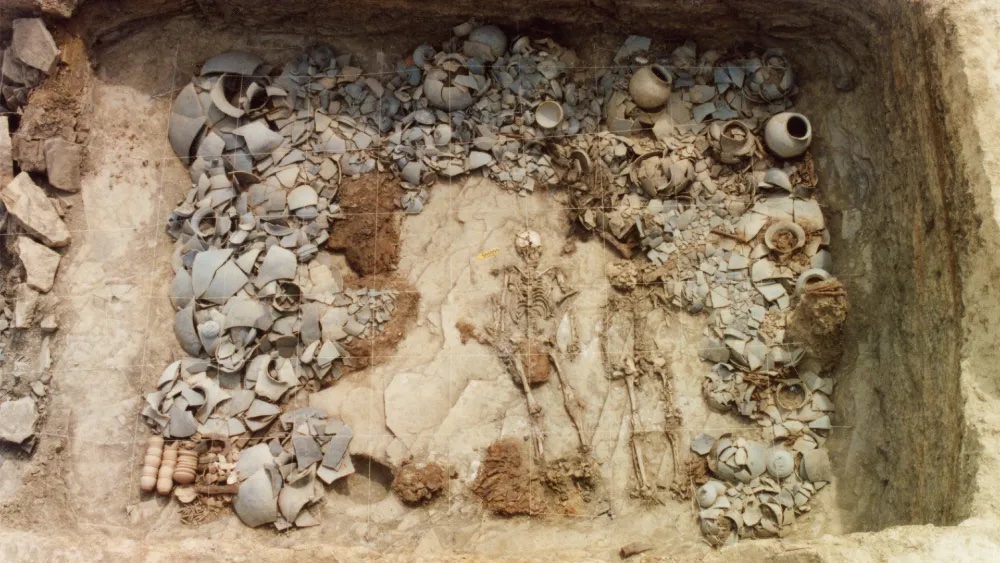
CLUJ-NAPOCA, ROMANIA—The skeletons of a medieval couple that had been buried holding hands have been unearthed at a monastery in Romania, along with the remains of a child. “We can see that the man had suffered a severe injury that left him with a broken hip from which he probably died,” said Adrian Rusu of the Cluj-Napoca Institute of Archaeology and History of Art. Scientists can only speculate that his partner died of a “broken heart,” since suicide would have prevented her burial in consecrated ground. The child may or may not be linked to the couple.
Did the Spanish Take Over Timucuan Structures?
ST. AUGUSTINE, FLORIDA—University of Florida archaeologist Kathy Deagan is looking for evidence of Europeans in St. Augustine in 1565. “It was the first settlement in Florida by Pedro Menendez de Avilés and it lasted for about a year until the Native Americans drove out the Spaniards,” she said. She is excavating a structure that may have been built by the Timucuans, based upon the post holes found in a circular shape, but used by the Spanish, who left behind an olive jar, tiny glass beads, musket balls, and pieces of metal. “The storehouse of the Spanish was struck by flaming Indian arrows and there was a big fire. Part of the building exploded because they had gunpowder stored there. We don’t know if that’s the exact thing we’re seeing here, but it could be,” Deagan added.
CANBERRA, AUSTRALIA—As many as 3,000 people may have made up the founding population of Australia, according to a controversial new study Alan Williams of Australian National University. He used a database of radiocarbon dates obtained from Australian cooking pits, human burials, shell mounds, and charcoal deposits, thinking that the growth of the human population would be reflected in the number of surviving archaeological sites. By calculating the rate of change in the population over time, and then using the population estimate in 1788, when Europeans arrived, he estimates that the population 45,000 years ago must have been between 1,000 and 3,000 people. Estimates based on the genetic diversity of modern aboriginal Australians have suggested a considerably smaller founding population. “It’s not just a family that got stuck on a raft and washed away. It’s people with the intention to move, to explore,” he said.
Han Dynasty Mirror Workshop Discovered
BEIJING, CHINA—More than 100 stone molds, foundry pits, wells, and pipes have been found in eastern China, at the ancient city of Linzi. Located within the site’s industrial zone, the workshop produced bronze mirrors some 2,000 years ago, during the Han Dynasty, when bronze mirrors, which had been objects owned only by the elite, were mass produced. The molds had been carved with images to decorate the highly polished metal objects. “It’s the first time that a bronze mirror workshop has been discovered, providing precious insights into technologists used for China’s ancient mirror making,” said Bai Yunxiang of the Chinese Academy of Social Sciences.
HONOLULU, HAWAII—Space archaeologists met at the annual meeting of the Society for American Archaeology earlier this month to discuss how the UNESCO World Heritage Convention could be applied to cultural heritage sites on planetary bodies beyond the Earth. For example, the Apollo artifacts on the Moon are owned by the U.S. government, but the protection of the Apollo landing sites could be complicated by the Outer Space Treaty of 1967. “What my colleagues and I are trying to accomplish is to legally protect a site of unprecedented human achievement on land that cannot be owned by anyone,” said Joe Reynolds of Clemson University. He thinks that the President could use the 1906 Antiquities Act to create a national monument on the Moon with an executive order, or Congress could pass the Tranquility Base National Historic Landmark Act. Also of concern are interplanetary spacecraft that are no longer functioning. They will “eventually enter interstellar space and become the archaeological representatives of Homo sapiens to the rest of the galaxy,” said Peter Capelotti of Penn State University.
1,000-Year-Old Minaret Destroyed
ALEPPO, SYRIA—The minaret of Aleppo's eleventh-century Great Mosque, a UNESCO World Heritage Site, has been destroyed by fighting between government troops and the Free Syrian Army. Both sides of the civil war claim that the other is responsible. Other parts of the mosque have been badly damaged, and artifacts such as a box said to contain a strand of the Prophet Muhammad’s hair have been looted according to some reports. The armies have been fighting for control of a military airbase located near the mosque.
Early European Farmers Mysteriously Disappeared
ADELAIDE, AUSTRALIA—People migrated from modern-day Turkey and the Near East to colonize Europe during the agricultural revolution of the Mesolithic period some 7,500 years ago, according to a new study of mitochondrial DNA taken from skeletal remains discovered in Germany and Italy. But their population was later replaced by another group. “What is intriguing is that the genetic markers of this first pan-European culture, which was clearly very successful, were then suddenly replaced around 4,500 years ago, and we don’t know why,” said Alan Cooper of the Australian Center for Ancient DNA.
Chambers Spotted Beneath Temple of the Feathered Serpent
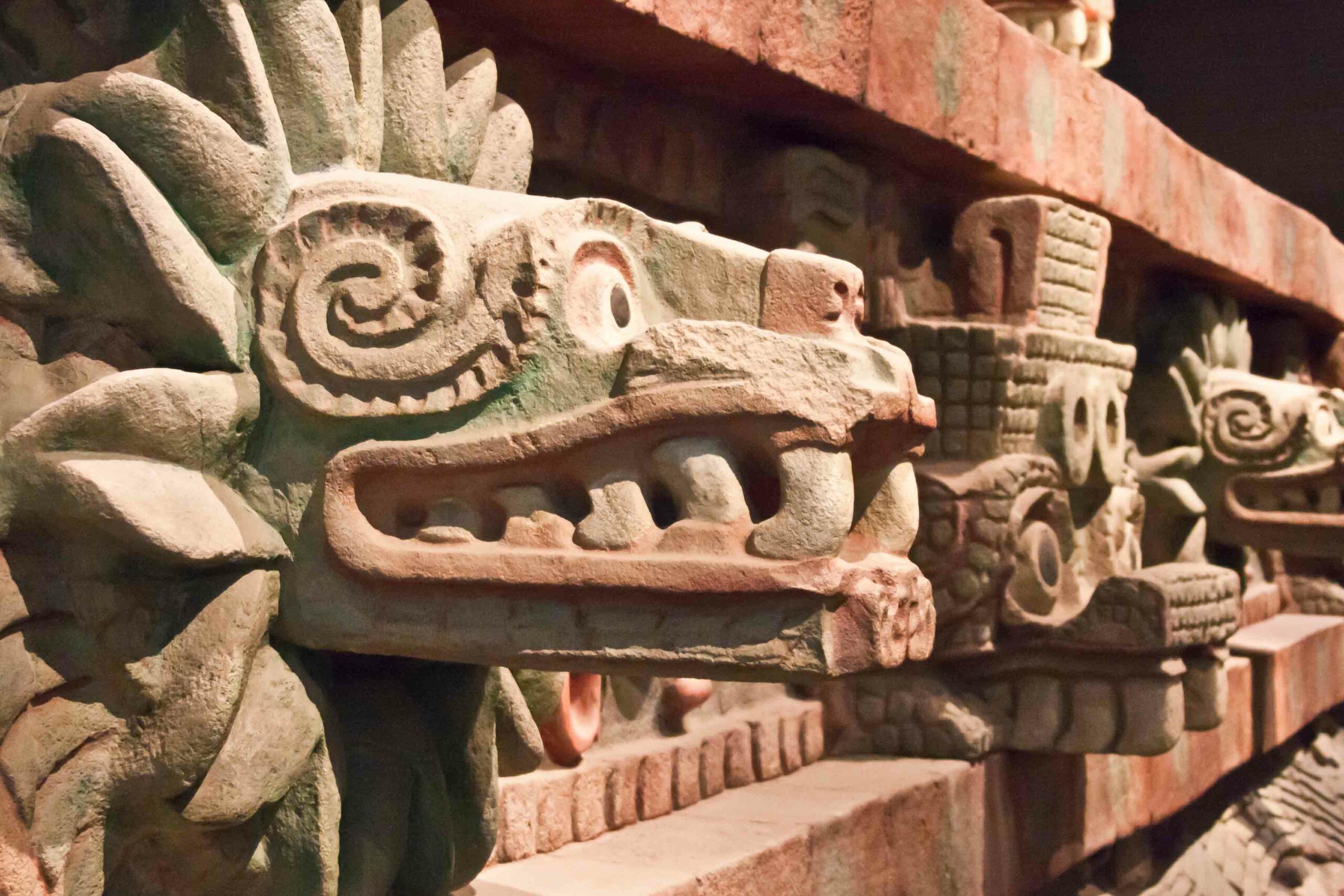
MEXICO CITY, MEXICO—Using the remote-controlled Tlaloc II-TC robot, researchers from the National Institute of Anthropology and History have discovered three chambers at the end of a 2,000-year-old tunnel at Teotihuacán’s Quetzalcoatl Temple. The chambers, now full of mud and rubble, may have been used for royal burials and ceremonies. No depictions of the city’s rulers or their burials have ever been found, but archaeologists plan to clear out this last section of tunnel for further investigation.
LEICESTER, ENGLAND—Researchers from the University of Leicester have been excavating a hillfort in the East Midlands for the past four years. They have uncovered a blue glass bead, and iron spearheads, knives, brooches, and a reaping hook. Bronze bucket fittings and trim from a shield have also been unearthed. Bone items include dice and other gaming pieces, and a flute. “All of the artifacts provide a remarkable insight into the lives of people who lived at Burrough Hill during the Iron Age,” said project director John Thomas.
OAXACA, MEXICO—A walled temple complex consisting of a main temple flanked by two smaller buildings and two possible residences for priests has been uncovered at the Zapotec site of El Palenque. Shell, mica, and alabaster ornaments; incense braziers; obsidian blades and lances; and ceramic vessels were uncovered in a room of the main temple building, which dates to 300 B.C. Archaeologists think this room may have been used for ritual bloodletting and animal sacrifice, and possibly even human sacrifice, since a human tooth and possible human limb bone were also found. A large kitchen area in this building suggests than many people could be fed at once, including the priests, whose residences contained serving plates but no cooking utensils. The complex was burned and no longer used sometime between the first century B.C. and the first century A.D.